


Read the Story
The Frostwild
Chapter One: The Crystal in the Snow
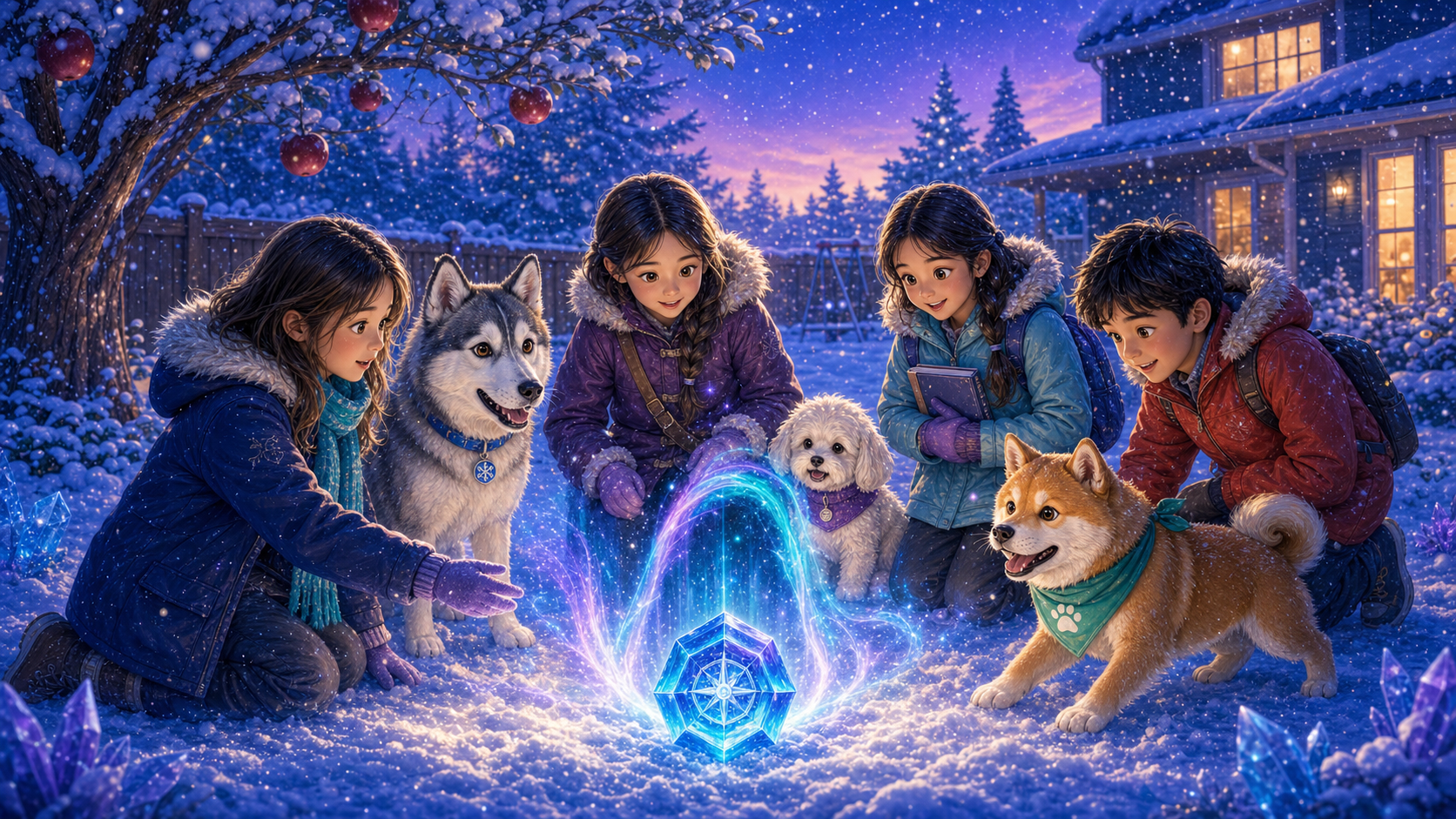
The snow had been falling since before breakfast.
Big slow flakes, the kind that came down like they had nowhere else to be. They piled on the porch railing in soft white loaves. They covered the bird feeder until it looked like a small frosted cake. They settled on the bare maple branches and made the whole backyard look like a page from a book somebody had not finished writing yet.
Astrid stood at the back door in her bare feet, watching the yard fill in.
It was Saturday. M was at the grocery store. Pods was on a long phone call in the office. Astrid had waffles still warm in her stomach and a whole afternoon ahead with nothing in particular to do, which her aunt Catherine always said was the best kind of afternoon.
Behind her, on the kitchen rug, Echo had opinions.
Echo, the Siberian husky, sat very straight, ears forward, watching the snow with the seriousness of a small wolf who suspected something. Her coat was the color of fresh cream and woodsmoke. Her eyes were the warm brown of bark in deep winter, and right now they were not blinking.
Astrid had grown up loving wolves. She had pictures of wolves on her bedroom wall, and a stuffed grey wolf on her shelf from a recent trip to Park Omega in Canada, and a notebook full of careful drawings of wolves howling at moons that were sometimes the right size and sometimes not. Echo was only a year and a half old now, but when her parents brought her home, Astrid had cried, because something special happened between them right away, and some part of her had known all along that this dog was hers.
"Echo," Astrid said. "What is it?"
Echo did not turn her head.
Astrid pulled on her boots without untying them, which was a thing her mother had asked her not to do, and then her mittens, and then her hat, which had a pompom on top that her aunt had knit too big and which Astrid loved exactly because it was too big.
She opened the door.
The cold was clean and quiet. The snow muffled everything. She could hear her own breath, and somewhere far away the chuff of a snowblower, and that was all.
That, and the glow.
It was past the porch steps, near the spot where the lawn dipped down toward the IMF club house their dad had been working on building them for what seemed forever. A pulse of blue. Then silver. Then blue again. Like someone had buried a tiny moon at the foot of the tree by accident and forgotten to come back for it.
Astrid stepped down into the yard.
The snow came up past her ankles. Each footstep made a small soft crunch. Echo padded out behind her, paws barely sinking into the drifts, the way huskies move on snow as if the snow is a different language they happen to speak.
She knelt by the glowing place and brushed the snow away with her mitten. The blue light got brighter the closer she got to it. The snow over the spot was cold, but underneath, the snow was warm, which was an extremely strange thing for snow to be in February in Minnesota.
Beneath the last layer of frost, sitting on top of the dirt as if it had always been there, was a crystal.
It was about the size of a maple leaf. It had six sides. It was shaped like a compass needle, only with edges as sharp as the inside of a star.
Astrid picked it up.
It was not heavy. It barely had any weight at all. It felt like holding a piece of cold sunlight.
The crystal spun once in her palm, slow and deliberate, like it was thinking. Then the long end pointed away from her body, out past the apple tree, out past the back fence, out past the neighbors' yards and the next neighborhood and the river beyond that.
It pointed north.
But it was not the north Astrid knew. It was a different north. A north with weight to it. A north that wanted something.
Echo gave one soft, serious howl.
Astrid felt it before she heard it: the warmth in her chest that always came when something important was about to happen. It was the same warmth she had felt the time she found her aunt Catherine's lost ring under the radiator. The same warmth from the night she dreamed of a thunderstorm three days before the thunderstorm came. The warmth she had always called, privately, in her own head, the knowing.
Behind them, footsteps crunched.
"That is not normal ice," Sydney said.
Sydney had her backpack on already, because Sydney always had her backpack on. The straps were bouncing against her shoulders. Her cheeks were a little pink from the cold. She had a notebook in one hand and a pen in the other and she had not even closed the back gate behind her, which meant she had come at a run.
"Hi," Astrid said, faintly.
"Hi," Sydney said. "I felt the air change. Did you feel the air change? The barometric pressure is doing something weird."
"How did you know to come?"
"I didn't. I was halfway here already."
Penelope appeared next, like Penelope often did, without making any sound. One second she was not there, and the next second she was crouched beside Astrid with her dark braid hanging over one shoulder and her eyes already cataloging the crystal. Behind her, just as quiet, padding through the snow on careful paws, was Omi.
Omi was Penelope's dog. He was a Maltipoo, a Maltese-poodle mix, and his coat was the color of pure white snow and his ears were the kind of ears that could pick up the sound of a snack wrapper opening from three rooms away. Penelope had taught him fourteen hand signals. Omi had learned all fourteen of them before his first birthday and then taught himself two more. He had been on more weekend missions than most adult humans had been on in their entire lives, and he understood the difference between a friend's footstep and a stranger's footstep before either foot had finished landing.
Penelope was Astrid's older sister. She was twelve, two years older than Astrid, and she was, also, the youngest person who had ever made it through CIA training. Their mother had not loved this fact. Pods, however, loved this fact. Their mother had also not been able to stop it. Most weekends Penelope was on a plane, and Omi was on the plane with her, and sometimes she came home with a small new scar and an even smaller smile, and on the weekends she was not on a plane she was at the rink, where she was a regional silver medalist in figure skating, which was useful for balance, footwork, and not being where people expected her to be.
The leather satchel at her hip, which she always wore and which she never explained, was therefore not a school bag.
"Markings," Penelope said.
She turned the crystal a quarter rotation. There were tiny lines etched along one of the faces, lines that ran in patterns like nothing Astrid had ever seen. Not letters. Not numbers. Something older.
"Symbols," Penelope said. "Not from any alphabet I recognize."
"That tracks," Sydney said, "considering it appeared in a yard."
The gate banged. Kyle came around the side of the house, trying very hard to keep up with Sydney, with snow on his shoulders and his coat half-zipped because Kyle did not believe in zipping coats all the way. Sydney was Kyle's older sister. Sydney was twelve, and Kyle was ten, and they had the same dark eyes and the same way of finishing each other's sentences when they got excited, which Sydney did more often. Trotting at Kyle's heel, looking very pleased to have finally caught up, was a small russet shape with a tail like a feather duster.
Boba was their dog. Technically he was the family dog, although Boba would have argued that the family belonged to him. He was a Shiba Inu, which Sydney said was a kind of dog from Japan and which Kyle said was a kind of dog with extremely strong opinions, and they were both correct.
Kyle took one look at the four of them gathered around the glowing thing and folded his arms.
"Okay," he said. "What did we find, and how dangerous is it?"
"Unknown," said Penelope.
"Glowing," said Sydney.
"Interesting," said Astrid.
"Possibly snack-related," said Boba, who had trotted past Kyle to investigate and now stood in a small dent of melted snow where his paws had unaccountably warmed the ground.
The crystal flashed.
It was not a bright flash. It was not a scary flash. It was the kind of flash a candle makes the moment before it catches the wick. A small sure flare, deep blue at the edges and white at the center. And after the flash, a ribbon of light unspooled out of the crystal and rose into the air above the yard.
It was the color of the northern lights.
It was the actual northern lights, except they were not in the sky.
They were ten feet above the snow, between the IMF shed and the pool, in Astrid and Penelope's backyard, on a Saturday afternoon.
The ribbon spread. Green folded into violet, violet folded into green. The colors moved like water and like fire and like neither. They braided themselves into the shape of a doorway. An arch tall enough for all five children to walk through, side by side, with the dogs at their heels.
Boba sat down so fast he fell over.
"I vote," he said, "that we discuss this indoors with biscuits and possibly a responsible adult."
Echo did not vote. Echo took one slow step forward, and then another, and stopped at the threshold of the arch with her tail high and her ears forward and the look on her face that meant she had already decided.
Astrid stood up.
She could feel the warmth in her chest now like a small bright bell. It was ringing the way it had rung the day Echo came home, when Echo looked at Astrid like she had been looking for her too, and Astrid had known without being told that this dog was hers and that she was Echo's and that some things in life are not chosen by the person doing the choosing.
She knew this was one of those things.
"The Frostwild is calling," she said.
She did not know how she knew the name. The name was just there, on her tongue, like a word in a language she had spoken once a very long time ago.
Sydney tucked a strand of hair behind one ear. "The what?"
"The Frostwild," Astrid said.
"That is a phenomenal name for a phenomenon," Sydney said. "I am writing it down."
Penelope adjusted the strap of the small leather satchel she always wore and which she never explained. "If you are going, I am going." Omi sat down at her boot and gave one quick decisive nod, which was hand signal number nine, which meant I am with you. Penelope put her hand on his head.
"Same," Kyle said. He finally zipped his coat, which is how Astrid knew he was serious.
Boba sighed the long sigh of a dog who had hoped for biscuits and instead got destiny. Then he stood up and shook the snow off his coat and trotted to Sydney's side.
"For the record," he said, "I am going under protest. But I am going."
Astrid reached down and rested her hand between Echo's ears. Echo leaned into her palm.
Together, girl and husky stepped into the arch.
The light folded around them like a closing book. There was a sound like a long single note from a deep silver bell. There was a moment of standing nowhere and everywhere at once. There was the feeling of being known by something very old.
And then the cold came up through the soles of their boots, cold of a different kind, and they were not in the backyard anymore.
Chapter Two: The Lantern Pines
The first thing Astrid noticed was that the light had a sound.
Not a loud sound. Not even really a sound the way that wind has a sound or footsteps have a sound. It was more like the hum a warm room makes when you walk in from the cold and your ears have been quiet for too long. A held breath. An unspoken yes.
The arch of aurora closed behind them with a soft low chord. The snow under their boots was a different snow now. It sparkled. Each step Astrid took kicked up a fine spray of glitter that hung in the air a moment longer than it should have before drifting down.
She looked up.
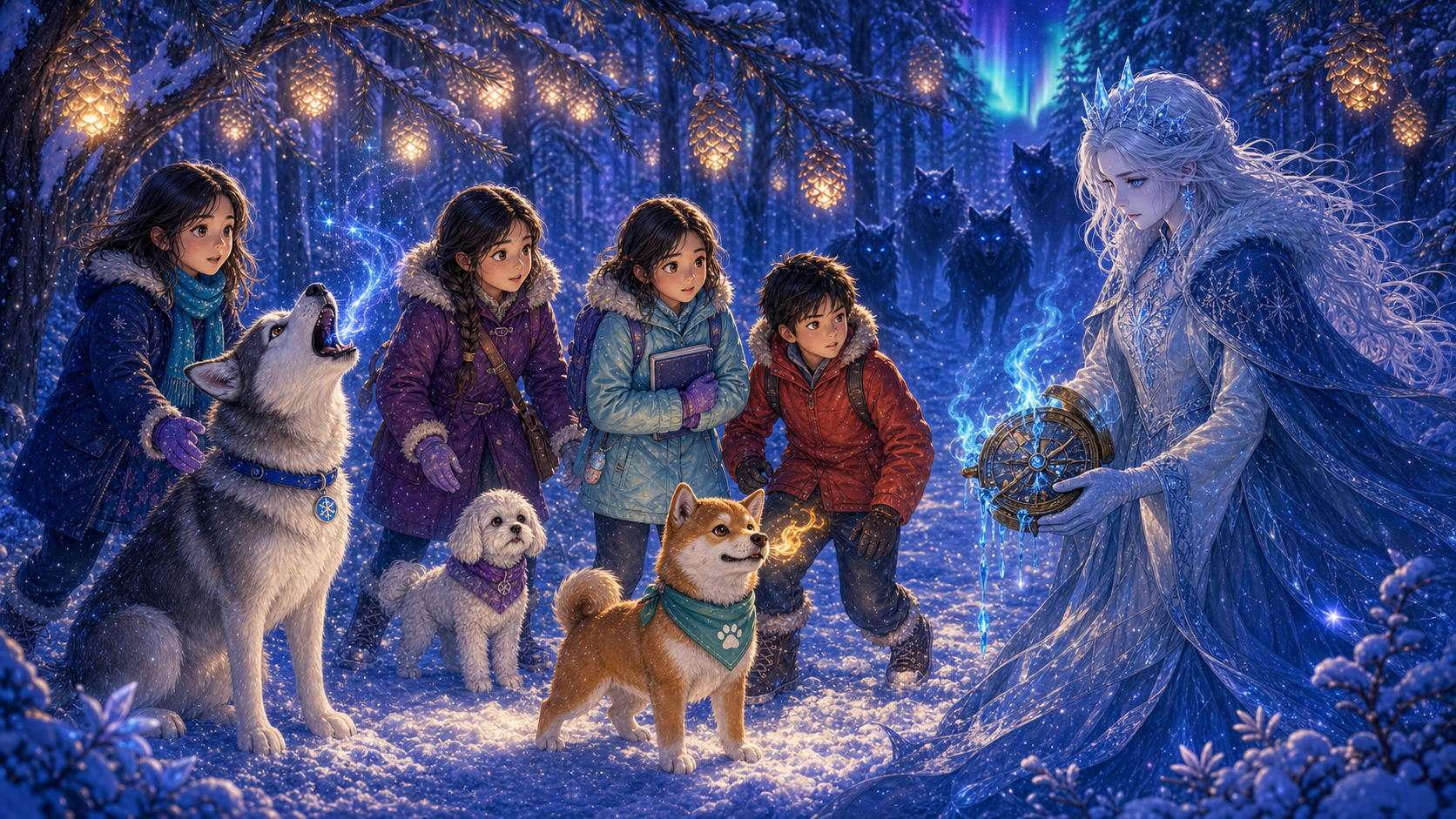
Trees rose all around them. Pines, but not pines like the ones at home. The needles were pale silver-blue, and every cone hanging from every branch glowed like a small lantern, a soft yellow-orange that pulsed in a slow rhythm, the way a heartbeat pulses if you put your fingers on the side of your own neck and pay attention.
A whole forest of lanterns. Thousands of small warm lights in the silver-blue dusk.
Boba sneezed.
A puff of golden flame popped from his nose. It made a small ring of melted snow around his front paws. The melted snow steamed gently. Boba blinked at it.
"I meant to do that," he said.
"Right," Sydney said. Her voice was a little high. "Right. Okay. So. We are obviously in another place."
"Astute observation," Kyle said.
"My hair is standing up on my arms," Sydney said. "Which means there are charged particles. Which means there is probably a magnetic field. Which means the aurora is real, but it is also a lot stronger than ours, and also possibly intelligent, and also possibly magic, which I am putting in quotation marks for now but I may take the quotation marks off later."
"Sydney," Penelope said. "Breathe."
Sydney breathed.
"Better," Penelope said.
Astrid turned a slow circle in the glittering snow.
The Lantern Pines stretched away in every direction. There was a path through them that she could feel more than see, a faint groove in the snow where some old purpose had passed. Above the trees, the sky was still mostly the deep blue of late afternoon, but at the very edge of the horizon, something stirred. Pale ribbons. Distant aurora, softer and farther than the arch they had stepped through.
The crystal compass in Astrid's mitten was still warm. She opened her hand and looked at it. The needle was pointing along the path.
"This way," she said.
They went.
The snow was not deep. The cold was not cruel. There was a quality to it, the way a person's voice is gentle when they are trying not to wake someone, that made Astrid feel as if the forest was being careful with them.
After a while, Penelope stopped.
"Look," she said.
She had crouched beside a stone half-buried in a drift. It was a marker, square and deliberate, with a flat top, and the snow had been blown clear of one face by some wind that had not blown anywhere else. On that face, carved deep into the stone, were symbols.
The same kind of symbols as the crystal.
Astrid knelt beside Penelope. She pulled off her mitten without thinking about why, and pressed her palm flat against the stone.
The cold of the stone went into her skin.
And then the cold became something else.
The world thinned. Astrid could still see Penelope and the snow and the trees, but they were quieter now, like a movie playing in another room. Inside her ears, she heard a voice. Not one voice. A lot of voices, layered, old and careful.
Guard the Icebound Star.
Trust the whole circle.
Beware Veyra Frostveil.
The voices repeated the third line a second time, slower. Beware Veyra Frostveil.
Astrid lifted her hand.
The world snapped back into clear focus. Her ears popped, gently.
Penelope was looking at her with the very steady look that Penelope had when she had questions and was choosing which one to ask first.
"You heard something," Penelope said.
"Three things," Astrid said.
She told them.
Echo, who had been standing with her ears forward the whole time, gave a low growl. It was not a loud growl. It was the growl that comes from somewhere much deeper than the throat. The growl of an animal that has just heard a name it does not like.
Beside her, Omi had gone very still. His ears, which had been soft and floppy, were sharp now, points up, swiveled toward the trees. He was hearing something the rest of them could not hear yet. He let out one short clean bark. Penelope had her hand on his back instantly. She knew what that bark meant. It meant footsteps, that direction, coming.
"Behind us," Penelope said. "Six trees over. Maybe four."
The wind shifted.
The lantern cones around them dimmed by a quarter, all at once, as if someone had turned a dial in another room.
A figure stepped out from between the pines.
She did not walk so much as arrive. One moment she was not there, between two silver-blue trunks, and the next moment she was. Her cloak was the color of breath in cold air. Her hair was so white it had no color at all. She had a face that might once have been kind, the way a stone might once have been a mountain, but a long erosion had happened.
In her right hand, she carried a compass.
The compass was beautiful and broken. The casing was bronze, etched all over with the same kind of symbols as the marker stone. The glass face had a long crack across it, and from the crack a slow blue fire leaked into the air, the way smoke leaks from a chimney.
"I am the only explorer," she said, "who ever truly understood this place."
Her voice was quiet. It carried anyway. The lanterns around her dimmed another notch.
"And you," she said, "are standing in my way."
Boba puffed out his chest.
"Good luck trying to get around us!," he barked. He was trying to sound large. He was a small dog, and the puff did not entirely work, but Sydney and Kyle felt a fierce love for him anyway.
The woman did not look at Boba. She looked at Astrid and Penelope.
"My name is Veyra Frostveil," she said. "The Icebound Star belongs to me. With it I will still every storm in this place. I will freeze every wandering path. I will make the Frostwild perfect, and quiet, and forever."
There was something in the way she said forever that made Astrid's chest hurt for her, a little, even before Astrid understood why.
"That sounds lonely," Penelope said.
It just came out. She had not meant to say it. It was not a clever thing to say to an enemy. She was almost embarrassed.
Veyra's face changed.
Only a little. Only for half a second. Around the eyes. Astrid saw it the way you see a shape under thin ice, a brief darker thing moving below the surface, and then gone.
"Children," Veyra said, "should not be in the Frostwild."
She lifted the cracked compass.
The blue fire that had been leaking from the crack did not leak any more. It poured. It poured down across the snow and into the spaces between the trees, and where it pooled, it stood up.
It stood up as shapes.
Six of them. Maybe seven. They were made of dark blue mist and the suggestion of teeth, and they walked on too many limbs to be any real animal. They had no real eyes, only places where eyes should be, and the places were burning a bad cold color. They were tall as men. They moved low to the ground in the way of things that had practiced being beautiful and given it up. The lanterns above them dimmed and dimmed.
"Frostwraiths," Veyra said softly, and the word felt like she had named them aloud not for the children but for herself, the way somebody confirms a thing they had hoped not to need.
Omi noticed that Echo did not bark. So Omi didn't bark either
That was the strange thing. Omi was the kind of dog who barked at the mailman as a matter of principle, at squirrels for sport, and at the vacuum cleaner with focused outrage. But Echo, looking at the cold tall shapes coming out of the snow, only stood very still. Her hackles were not even up. Her tail was low and uncertain. It was the tail of a dog seeing something she half-recognized and could not place.
Astrid noticed. She noticed it the way a person notices a smoke alarm chirping in a far room. Some part of her filed it away.
Sydney made a sound that was not quite a word.
Kyle stepped in front of her. Kyle was ten, and not tall, but he had the kind of jaw that decided things ahead of the rest of him. "Astrid," he said, without turning his head, "now would be a good time."
Astrid reached for her power.
It was not a thing she could explain. It was the warmth in her chest, the bell, the knowing. She let the warmth come up through her shoulders and down into her hands. Beside her, Echo planted her four paws in the snow and lifted her head.
Echo howled.
It was the howl from the back porch. It was the same note Echo had given when Astrid had first uncovered the crystal. But here, in this place, the note was louder. It rang. It rang the way a bell rings when somebody hits it on purpose, full and clear, a single round sound that shook the lantern cones in the trees.
Astrid's hands filled with light.
The light was star-light. It was white at the center and blue at the edges and it tasted, somehow, of the warmth in her chest, made visible. She did not throw it. She did not have to. Echo's howl was the wind. Astrid's light was the lamp. The wind carried the lamp.
The frostwraiths shattered.
They did not melt. They did not run. They came apart into snowflakes, all at once, six or seven exhalations of cold dust, and the snowflakes drifted down and lay quietly on the ground and were just snow, after that.
The lantern cones brightened back to their soft, warm color.
Veyra Frostveil watched the snow settle.
Her face did the small change again. This time it was longer. Half a second became almost a whole one. Then her mouth set into a line.
"So," she said. "The star-pair has come."
"The what?" Sydney whispered.
Veyra did not answer Sydney. She did not seem, anymore, to find children worth answering at all. She lifted the cracked compass to her chest, and the blue fire wrapped her, and she vanished, the way frost vanishes from a window when the sun comes through.
For a long moment, nobody spoke.
The forest hummed its small held-breath hum.
Echo turned her head and pressed her nose against Astrid's leg, and Astrid bent down and put both arms around the dog's thick neck and held on for a count of four.
"Okay," Kyle said. He let his shoulders drop. "Okay. So that was a thing."
"That was several things," Sydney said. She had her notebook out again. She had not taken her glove off, and she was trying to write through the glove. "I have so many questions. So many. Star-pair. Frostveil. Why do the cones glow brighter when she goes away. Why does the air taste like batteries."
"It tastes like batteries to you?" Penelope said.
"A little," Sydney said. "Not in a bad way."
Boba sat down in the snow and looked extremely tired. "I would like to go on record," he said, "that I performed several acts of bravery, and I would like a biscuit."
Sydney kissed the top of his head.
"Later," she said. "We will get you all the biscuits."
Astrid stood up. The compass in her hand was warm again, and steady, and pointing further along the path, deeper into the silver-blue forest, toward the mountains they could just begin to see between the trunks of the Lantern Pines.
"First," she said, "we keep going."
Chapter Three: The Skyglass Caverns
The path out of the Lantern Pines went up.
It went up gently at first, the way a sledding hill goes up gently before it gets serious about being a hill. The lantern cones got farther apart. The silver-blue trees thinned. The snow underfoot grew firmer, almost crusted, which Sydney said was a sign of altitude and which Boba said was an ankle hazard.
After half an hour the trees stopped altogether.
What they stepped into was a valley between two long stony ridges, and that valley was a wind tunnel.
Sydney called it the Whisperdrift Pass because there was a sign at the entrance, a tall narrow stone with a single word carved into it in the strange letters, and somehow Sydney recognized the word was WHISPERDRIFT. None of them had any idea who had put up a sign in the middle of a magic place, much less how Sydney was able to read it. Penelope said maybe somebody from home had been here before, and she did not say it lightly. Sydney said maybe the place put up whatever sign your brain expected. Astrid said both could be true.
In the pass, the wind blew along the valley floor in long low scarves of snow.
It also talked.
It did not talk loudly. It did not talk in sentences exactly. It used pieces of sentences. It used pieces of their own voices, even, the way a recording might play back something you had said, but tilted, twisted, with the meanings shifted slightly.
Turn back, the wind said.
Then, in what sounded like Astrid's dad: It is too cold for you out there.
Then, in something that was almost Echo's voice, which was not possible because Echo's voice was a howl: Go alone.
Then: Trust only power.
Astrid pulled her hat lower over her ears, and the wind did not stop.
"Don't listen," Penelope said. She had her head down. Her braid was whipping. "Whatever it is saying, don't listen."
"I am trying not to," Sydney said. Her face was tight. "It keeps using my brother's voice."
Kyle's jaw was set. He did not say what the wind was saying to him. He did not need to. Astrid could see it in his shoulders.
Boba was the only dog who seemed unaffected. Boba kept walking. Boba was muttering to himself, "Snack thoughts. Snack thoughts. Roast chicken. Sweet potato chew. Snack thoughts." He was, Penelope realized later, doing a very wise thing without knowing it. He was filling his head with something too loud for the wind to talk over.
Omi was the other unaffected one, although for a different reason. Omi could hear the wind speaking to each of them in voices he was not supposed to hear, and he had been trained, since he was a very small puppy, not to take orders from voices that were not Penelope's. Penelope, walking beside him, gave him hand signal seven, which meant stay close. Omi stayed close. Echo did the same on the other side, between Astrid's knees.
Astrid was not so wise.
The wind started talking to her in her own voice.
You can move faster without them, the wind said.
She tried to ignore it.
You and Echo. The two of you. The star-pair. You are different. You always have been. They will only slow you down.
She put her hand on the back of Echo's neck and squeezed. Echo turned her head and looked up at her with the warm brown eyes, and the wind did not stop, but for a second Astrid did not hear it.
But only for a second.
By the time they came out the far end of the pass, into a quieter snowfield where the wind was just wind again, something had gotten in.
Something small and itching, like a sliver under a fingernail.
They made camp at the snowfield. Penelope found a stone overhang where the wind could not reach. Sydney started a tiny fire using a piece of glow-cone she had gathered from the Lantern Pines, which she had wrapped carefully in birch bark and which she said burned three times longer than wood. Kyle dug out small bowls in the snow for the dogs to drink from, and Boba supervised.
They ate granola bars and drank from a thermos.
Astrid watched her friends in the small warm light of the cone-fire.
Sydney was smudging something into her notebook with a glove. Penelope had her boots off and was rubbing her socked feet, with Omi curled against her ankle. Kyle was poking the fire with a stick and Boba was leaning against his leg.
Astrid loved them.
She loved them so much it hurt, and the hurting itself was the problem, because if you love people that much, then you can lose them. And if you lose them, the world breaks. And the wind in the pass had told her, in her own voice, that the way to keep them safe was to not need them so much.
She did not really believe the wind.
She sort of believed the wind.
She did not know which was worse.
In the morning they walked.
The compass kept pointing toward a wall of white cliffs ahead, and Astrid kept walking, and after a while she was walking faster than the others. She did not mean to, exactly. She just did. Echo padded beside her, easily. The husky was made for this snow. The husky did not slow down.
Behind her, the others slowed down.
Sydney stopped to study a place where the snow had crystallized in tiny six-pointed stars, all lined up in rows as if a child had pressed them into the drift on purpose. Penelope paused at every turn in the path, scanning the rocks above them for movement. Kyle insisted on testing a snow bridge over a small ravine before letting anybody cross, by stepping out onto it himself
Boba had to be carried over the ravine by Kyle, because Boba flatly refused to walk on the snow bridge under any circumstances. Boba narrated his rescue. The narration took a while.
Finally, Astrid turned around.
They were halfway across a long flat stretch of snow that ran up to the white cliffs. The cliffs were closer now. She could see the entrance at the base, a tall pointed arch that opened into darkness and which was not dark at all but instead full of soft white light, the way a jar full of fireflies is not really dark.
"Echo and I can move quicker alone," Astrid said.
The words came out of her mouth before she had finished deciding to say them.
Sydney stopped walking. Her notebook was still open in her hand.
Boba's ears, which had been cheerful, drooped at the tips. He had been carrying a little stick he had picked up. He let the stick fall.
"Alone-alone?" he said, in a small voice.
"I just mean," Astrid said. The words were already wrong. "I just mean, the Icebound Star is important. Echo and I have the strongest magic. We should lead. The compass is responding to me. To us. It will be faster if I can just, you know. Run ahead."
"We are going as fast as is safe," Kyle said.
He was not looking at her.
"I thought we were all leading," he said.
His voice was even. It was not angry. That was almost worse.
Sydney closed her notebook. Slowly. "The crystal signal is unstable," she said. "The magnetic field in this part of the valley is doing something I have not figured out yet. Rushing into a thing you do not understand is, statistically, a bad idea."
Penelope did not say anything.
Penelope, when she did not say anything, was an entire sentence.
Astrid opened her mouth. She wanted to say, you don't understand, I am trying to keep you safe. She wanted to say, the wind told me. She wanted to say, please don't be hurt. What came out of her mouth was, "We do not have time to argue."
She turned and kept walking.
Echo did not follow at first.
Echo stayed for one beat, two beats, looking at the others. Then she trotted up beside Astrid, but slower than usual, as if she was registering a complaint that she did not have the words for.
The arch in the cliff loomed closer.
Astrid did not look back.
When she stepped under the arch, the white light of the caverns wrapped around her, and the cold inside was a different cold, and behind her she could hear the others coming, but a long way behind, and she made herself not care.
The Skyglass Caverns were a wonder.
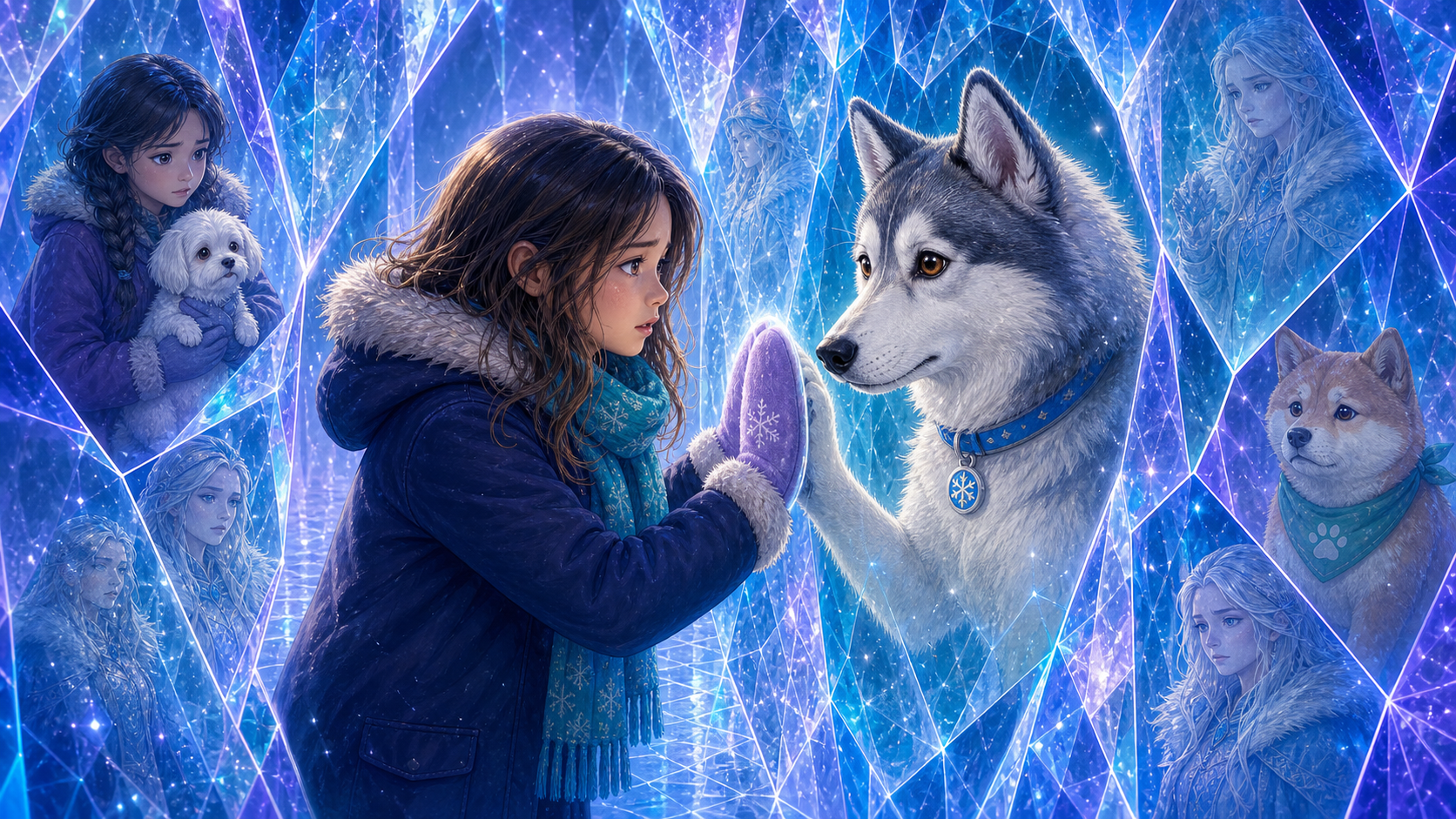
The walls were not stone. They were ice, but ice the way diamonds are stone, ice cut and polished by something patient. Every wall threw back a reflection. Every reflection was a little different from the others. The cavern was tall enough to fit a church, and so wide in places that the far wall was only a glimmer.
When Astrid raised her hand, fifty hands rose. When Echo took a step, fifty huskies stepped.
Astrid walked in the middle of an enormous bright crowd of herself.
In one shard of wall, she looked taller than she felt. In another, her hair was longer, the way she always wished it was. In another, she was alone, and the alone version of her looked almost peaceful, and Astrid tried not to look at that one for too long.
Then she saw a reflection that did not match.
It was Boba.
He was small in the shard, and he was standing behind her, and his shoulders were down. He did not look angry. He looked like a small dog who had been told he was extra.
Astrid stopped walking.
"Boba?" she said.
Her voice bounced off a hundred walls. The bounces did not all come back at once. They staggered. Boba? said the cavern. Boba? Boba? Boba? Each one a little flatter than the one before.
She turned.
The cavern had changed.
She had not heard it change. She had not seen it change. But where the entrance had been, now there were five tunnels. Five mouths in the ice, each of them lit with the same soft white light, each of them looking exactly equally promising and exactly equally wrong.
"Sydney?" she called.
Sydney? said the cavern. Sydney? Sydney? Sydney?
"Kyle? Penelope?"
The names came back to her broken into pieces.
Echo barked. Her bark also bounced strangely. It went down two of the tunnels and came back wrong. It came back with extra echoes that did not match the bark. The husky's hackles went up.
Astrid spun in place.
In every shard of wall, she could see herself spinning. In one wall, she saw Echo, but Echo was not next to her. Echo was inside the wall.
Inside the wall.
The husky's eyes were warm brown and panicked, and her paws were braced wide, and her mouth was open in a soundless bark, and there were no echoes for it because the wall had taken her sound.
"No!" Astrid said. "No, no, no."
She ran to the wall.
She put her hands flat on the cold smooth surface. The wall was hard as a frozen lake. Echo, in the wall, scratched at her side of the surface. Her paws made no sound. She was a foot away. She was a thousand miles away.
A laugh drifted through the cavern.
It came from every shard at once. Veyra Frostveil's reflection bloomed in a hundred walls, multiplied, fractured, calm.
"The Frostwild," she said, "shows what is already cracked."
Astrid threw star-light at the wall.
It was a clumsy, frightened throw, not like the careful warmth in the Lantern Pines, and it fizzled against the surface like steam against a window. The wall did not even ripple. Echo, on the other side, kept scratching.
Astrid tried again.
It was thinner this time. Smaller. The light came out of her hands like a held-back sob.
She knew, with the knowing, what was wrong.
Her power was not weak because Echo was trapped, exactly. Her power was weak because she had told herself, an hour ago, that she did not need her friends. She had said it out loud. She had walked away from them. The bell in her chest had been ringing in her own voice all morning, and she had not been listening.
The hundred Veyras smiled.
"You came in alone," they said. "How are you finding it?"
Chapter Four: The Rescue
Boba did not know what tunnel he was in.
One minute he had been at the back of the line, doing his best dignified trot, and the next minute the cavern had folded around him like a closing book and he had been somewhere else.
The somewhere else was foggy.
The fog was the kind that glittered. It was not like fog at home, which was gray and damp and smelled like wet leaves. This fog smelled faintly of cold metal and looked like the inside of a snow globe right after you have shaken it. There was no ground under his paws that he could see. There was only fog, and there was only him.
"Hello?" he barked, in his best brave voice.
His best brave voice was not actually all that brave. It came out a little squeaky. He cleared his throat and tried again.
"Hello!" he barked. "Brave sidekick available for rescue or snacks!"
Nobody answered.
He turned in a small circle. Shibas, when they are anxious, like to confirm that all sides of themselves are accounted for. All four sides of him were accounted for. He was a complete dog. That was something.
A shape moved in the fog.
It was big.
Boba's tail, which had been doing brave little sweeps, stopped sweeping.
The shape was tall and wrong. It walked on long limbs that did not all bend the right way. Cold blue at the edges. Hollow where the eyes belonged. It slid, more than walked. It was a frostwraith. Boba had no name for it then, but he knew, the way small dogs know things, that this was the kind of shape his ancestors had warned about in the long dark winters before there were houses.
Boba tried to summon his flame.
He had only sneezed flame once, by accident, in the Lantern Pines. He did not really know how to do it on purpose. He tried scrunching up his nose. He tried thinking warm thoughts. He tried thinking about roast chicken, which usually fixed most things.
A tiny spark popped from his nostrils. It hung in the air for a half second and went out.
The shape slid closer.
Boba's small heart did a small terrified thing inside his chest.
He thought, then, about Astrid.
He thought about how she had walked away from them on the snowfield. How her shoulders had been set. How she had said we do not have time to argue. How she had not turned around when he had let his little stick fall.
His chest hurt.
It hurt in a particular spot, right under the place his collar usually sat, and it hurt because he was a small dog who had been told, without it being said out loud, that he was extra. That he was the one who could be left behind. That when the moment came, he would be carried, like he had been carried over the snow bridge.
He was tired of being carried.
"I may be small," he barked, planting all four of his paws into the not-ground of the fog, "but I am not extra."
The shape lunged.
Golden fire burst around him.
This time it was not a sneeze. This time it was not an accident. It came up out of him in a clean warm rush, the way a real bark comes from the chest and not the throat. It rolled off his fur in a halo. It lit the fog.
The shape squealed. It was a thin small sound, the sound of a thing that had been pretending to be larger than it was, and then it crumpled and dissolved like a wet paper sketch.
The fog parted.
In the gap, Boba saw a glimmer at the end of a long ice corridor. A reflection. A friend.
He started running.
In another tunnel, Penelope was watching her friends forget her.
That was what the wall was showing her. A curtain of mirrored ice, polished like a screen, and on it Astrid was laughing with Sydney and Kyle in Astrid's kitchen, the kitchen that was also Penelope's kitchen, in the house Penelope had lived in her whole life. They were eating popcorn. Boba was upside down on the rug. Penelope, who had been Astrid's older sister since the day Astrid was born, was not in the picture. Was not in the room. Was not in the house.
It was a very good fake.
Omi knew first. He stood at her boot with his ears swiveled hard at the curtain, and he was making the low sound in his throat that meant what I am hearing does not match what I am seeing. Penelope put her hand between his ears. He pressed his head into her palm. He told her, in the wordless way they had been talking since he was a puppy, that the popcorn had no popping sound, the laughter had no breath behind it, and behind everything the wall itself sounded hollow.
She trusted him completely.
She had been a CIA case officer in unofficial cover since she was seven. She had been keeping track of small wrong things since she was three. When Omi told her something was wrong, she did not waste time questioning it.
She looked closer.
The popcorn in the fake kitchen had no steam coming off it. Just-popped popcorn always steams.
Penelope smiled. It was the smile of a girl who had just caught a magic trick.
She unfastened her satchel and took out the silver mirror her aunt Catherine had given her, the one she used for looking around corners. She held it up, angled it, and walked backwards into the fog. Omi stayed at her heel.
That was when the gold flash cut through the fog ahead.
Boba.
She turned and followed the gold, because she trusted Boba more than she trusted any wall, and Omi followed because Omi went where Penelope went.
Boba's flame in the fog had not just defeated one frostwraith. It had burned through the illusion the cavern was using to keep them apart. By the time Penelope and Omi caught up to the running gold flash, the five tunnels had begun folding back into one. They came around a corner, and there were Sydney and Kyle, running flat-out from a different direction, Sydney with her notebook out and Kyle with his coat unzipped. Then the corridor opened. Then they were all together. Then they were running for the central cavern, where Astrid was kneeling at the wall.
She had her hands flat against it. Her star-light was a small guttering thing. She was crying without making a sound.
"Astrid," Sydney said.
Astrid looked up.
Echo, on the other side of the wall, sat very calm. The husky's brown eyes were locked on Astrid the way a compass needle locks on north.
The cavern groaned.
It was a sound like a cathedral leaning over. The walls of the central chamber, which had been smooth and softly lit, now showed long dark cracks running floor to ceiling. The air smelled different. It smelled like a room someone had decided to leave for the last time.
A laugh drifted through the ice.
Veyra Frostveil's voice. Calm. Far away.
"You should not have come down here," she said. "I could not move the Star without the children of the Frostwild standing in my way. So I have decided to leave you here."
Sydney went still.
That was Sydney's still. Sydney's still meant she was working, fast, behind her eyes.
"Astrid," Sydney said quietly, "step back from the wall."
Astrid looked at her.
"Trust me," Sydney said. "Step back. Stand up. Put your back against the column behind you. Pour your star-light up. Up at the ceiling. Hold the cracks. As much as you can. As long as you can."
Astrid did not ask why.
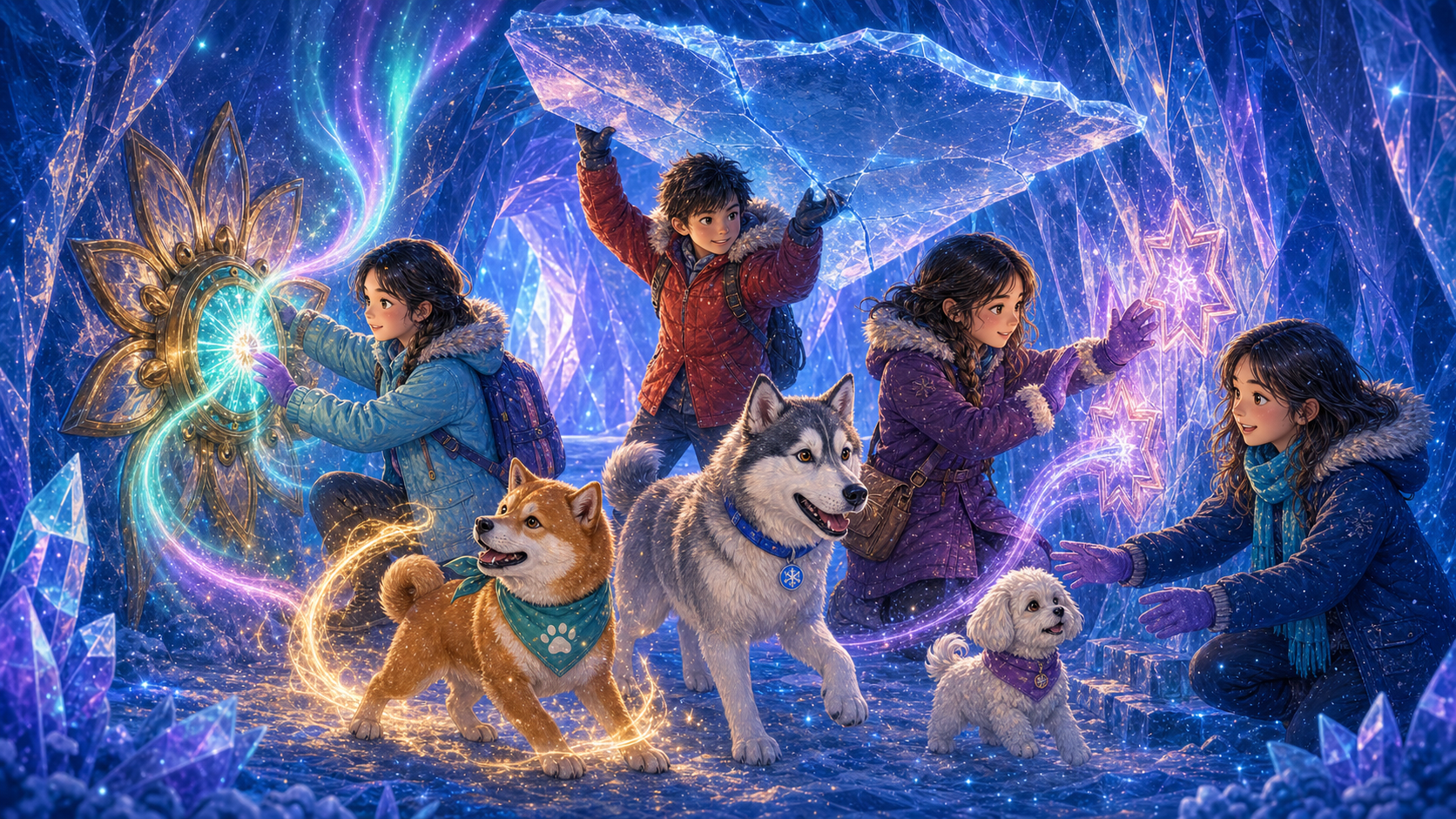
She stepped back. She rose. She put her shoulders against the column. She lifted her hands and pushed star-light up toward the ceiling, careful, focused, and the worst of the cracks above them glowed a thin warm gold and slowed.
"Kyle," Sydney said.
"Here."
"That fallen beam of ice in the corner. Brace it. If it goes, half this floor goes."
Kyle went.
"Boba. Stay near Astrid. If her star-light starts to fail, warm her hands. Just her hands. Keep them moving."
Boba trotted to Astrid's heel and sat down with his small chest already glowing.
"Omi. Listen for any new crack starting anywhere we have not noticed. Bark loud."
Omi planted his paws and turned his ears.
Sydney took a long breath.
She pulled off her glove. She pressed her palm to the wall.
"Penelope," she said, "I need you with me."
Penelope crouched beside her.
"This is not just a wall," Sydney said. "This is the whole structure. This is what is holding the cavern up. Veyra did not just trap Echo. She tied Echo to the keystone. If we want Echo back, and if we want to live, we have to take this wall apart from the outside in. And I think it is going to be ugly."
Penelope nodded once.
"Tell me what to do," she said.
The wall had a frame.
Sydney had not noticed it before, because in the first frantic minutes she had been looking at Echo and only Echo. But now, with her palm flat on the surface and her eyes drawn back, she saw it. The wall was set in a frame of dark stone, and the frame was carved with symbols. They ran around all four sides in a careful unbroken band. Hundreds of them. Each symbol was a small star or hexagon or spiral or rune, none repeating in any obvious way.
It looked like decoration.
It was not decoration.
"It is a number sequence," Sydney said. "Look. Each symbol is a digit. There are twelve different shapes that repeat. Twelve. Not ten. So the base is not ten. It is twelve. They count in twelves here. They count by lanterns."
Penelope was already with her. She had her finger on the first symbol. "This one is one. This one is one. This one is two. This one is three."
"Five," Sydney said. "Eight. Thirteen. Fibonacci."
"In base twelve."
"In base twelve. With a shift."
Sydney's mind was running. The symbols were not in raw Fibonacci order. They were Fibonacci numbers transformed through a Caesar shift, the kind of cipher where every digit moves a fixed number of places along the alphabet. The shift parameter was not yet visible. To find it, she needed to identify the shift implied between two known terms, and then run that shift across the rest.
"Penelope. I need three consecutive symbols I can read clearly. Top of the wall. Eye level. Bottom. Tell me which shapes."
Penelope walked the wall. The cavern shuddered. A piece of ice the size of a bread loaf cracked off the ceiling and fell behind Astrid. Astrid did not flinch. The thin gold of her star-light brightened.
"Top corner," Penelope called, "spiral, then star, then hexagon."
"Eye level under the top corner?"
"Same three shapes. Different order. Star, hexagon, spiral."
"Bottom corner?"
"Hexagon, spiral, star."
Sydney closed her eyes.
She did not need pen and paper. The numbers were already moving. Three symbols, three orderings, two known Fibonacci pairs. Solve for the shift parameter. Solve for the next term in the sequence. Find the symbol that corresponds. Find its match somewhere on the floor.
Sydney was six the first time she understood she was different.
It was at her cousin birthday party. The kids were playing tag in the backyard. Sydney had brought her algebra textbook because her mother had said she's working through algebra in the proud quiet voice mothers use about their kids when they want you to understand. Sydney had finished the algebra textbook in February. She did not really want to play tag. She did not really know how. The other kids ran in patterns she could not predict. They shouted at each other in ways she did not have the rhythm for. So she sat on the edge of the wooden deck with her textbook in her lap, and because she had already done all the problems, she had brought a clean notebook too, and she was working through differential equations from the back of a college book her father had on a shelf.
Another mother came out with a tray of juice boxes.
She paused.
She looked at Sydney's notebook for a long second. She looked at Sydney. Her face did a small thing. Sydney did not have the word for it then. She has the word for it now. The word is afraid. Another parent of another child was afraid of what Sydney was doing on the deck.
That was the first time Sydney understood that being able to do a thing other people could not do was not always good.
It was the start of a long quiet downward narrowing. In the spring of kindergarten, she stopped raising her hand in math because the kids started saying her name in a particular voice. By the start of first grade, she had stopped reading her science books at recess because one of the Chinese teachers took her aside and said hey, you should go play. Sometime in first grade, she stopped telling her two moms what she was thinking about. Her mom Felicia was a property manager. Her mom Amy was a Major in the US Army and a physician, often gone for stretches, and Sydney loved them both, she really loved them, but Felicia could not always follow what was in Sydney's head, and Amy was on a base in another time zone, and what Sydney was thinking about was getting harder to put into words that would keep, by phone, across an ocean. By the start of first grade, she ate lunch alone almost every day. She had a regular spot. The bench at the back of the playground, behind the cedar tree, where the noise of recess thinned out and she could read a book about prime numbers without anybody saying her name in any voice at all.
She did not feel sorry for herself.
She knew that being smart was supposed to be good. Adults had told her this. Teachers had told her this. Her parents had told her this. So if it was good, then the loneliness had to be something else. It had to be her, doing it wrong. She just had not yet figured out how to do it right.
She thought about it a lot, on the bench, behind the cedar tree, with her book.
She thought she was the only one of her in the world.
Sydney opened her eyes.
"The shift is five," she said. "The next term in the sequence, the one that completes the wall, is sixty-eight in base twelve. That is the symbol of two crossed hexagons."
Penelope was already scanning the floor.
"There," Penelope said. The floor of the central cavern was paved with white tiles, each carved with a single symbol. Hundreds of them. Penelope was crossing the floor on quick light feet, eyes flicking, eliminating, and on the third corner of her sweep her boot stopped over a tile near the base of the wall.
She knelt.
She put her thumb against the tile.
She pressed.
"Two crossed hexagons," she said.
"Press it."
Penelope pressed.
The tile gave under her thumb with the soft clean click of a thing that had been waiting a long time to be touched correctly.
The wall trembled.
Then the outer layer of the wall, two inches thick, slid sideways and disappeared.
Behind it, set into a darker layer of stone, were seven concentric stone discs.
They were the size of dinner plates. They were set into the inner stone like a clockwork puzzle. The outer disc had twelve teeth on its edge. The next had eleven. Then nine. Then seven. Then five. Then three. Then a single tooth at the center, on a disc the size of Sydney's palm.
Each disc had a fragment of a seven-pointed star carved into it, broken across all seven discs.
To unlock the layer, the seven fragments had to align.
"They counter-rotate," Sydney said. "Each disc is geared to the one outside it. If you rotate disc one, disc two moves the other direction. The ratios are different. I need to know the ratios first. Spin disc one a single notch. Watch what disc two does."
Penelope put her thumb to the outer disc.
The cavern shuddered. A long ribbon of ice cracked free above them and dropped. Astrid's gold light caught it midfall. The ice slowed, hung, and drifted down sideways like a dropped feather, harmless, in front of Boba, who looked up at it and said, Thank you, Astrid, in a small voice.
Penelope pushed.
The outer disc moved one notch.
The second disc rotated. Sydney watched the angle. "Five notches counterclockwise per one notch clockwise. Seven to five gear ratio. Disc three?"
Penelope spun the second.
"Three notches counterclockwise per one notch clockwise. Eleven to three."
"Disc four?"
"Two notches per one. Nine to two."
It went on. Sydney built the ratios in her head, one after the other. She did not write them down. She did not have time to. The cavern was groaning now, almost continuously, and a fine rain of ice dust was falling in the beams of starlight that came through cracks in the ceiling. Astrid's arms were shaking. Kyle was bracing the fallen ice beam in the corner with his back, his boots planted, blood on his forehead from a chunk that had clipped him earlier.
"Okay," Sydney said. "Disc one. Seventy-three degrees clockwise. Disc two will follow on its own. When disc two has moved forty-one degrees, stop disc one and turn disc three twenty-eight degrees clockwise. Then both will hold each other. Disc four, sixty-six degrees counterclockwise. Disc five will follow. Then disc six, twelve degrees clockwise. Disc seven, you do not turn. It will move on its own when the others align, or it will not, and then we have a problem."
Penelope did not say got it. Penelope's hands were already moving.
Penelope was five the first time the men in coats came to her house.
There was only one of them at the door, actually. He was tall and wore a gray wool coat and carried a leather briefcase. He had asked for her by name. Her mother had let him into the kitchen with the particular tightness around the mouth that her mother got when something she could not control was happening in her own house. She had a sneaking suspicion that Pods knew exactly what was happening.
The man in the trench coat had set the briefcase on the kitchen table. He had opened it. Inside was a wooden cylinder about the size of a paper-towel roll, with rings of letters carved into its surface, and a small printed page beside it with a single phrase:
Find the word.
He had not said hello. He had said, "If you can solve this, I would like to talk with your parents."
Penelope had picked up the cylinder. She had turned the rings. She had thought about the printed phrase. Three minutes later, she had set the cylinder back on the table with the right rings aligned and a single eight-letter word readable along the cylinder's spine.
The man had looked at her for a long careful second.
He had said, "Where did you learn that?"
She had said, "Nowhere. I just looked at it."
He had nodded once. Slowly. Then he had looked at her parents.
They could not officially recruit a minor. There were laws about that even in the agencies that were not supposed to exist. What they could do was offer something called a youth development program, the kind of thing that was technically run by a private foundation and that technically only assessed her every six weeks at a nondescript office in Tysons Corner, Virginia and that technically never asked her to do real work. Technically.
She started codebreaking at seven. By then she had spent nine days alone in a Vermont forest at age six as part of what they called fieldcraft basics. She had killed a fish with a sharpened stick. She had purified water with charcoal. She had not cried.
She had liked the forest.
She had not liked the men in the gray coats. The men looked at her the way you look at a tool. They wanted to know what she could do. They did not particularly want to know who she was. She had figured that out by her eighth birthday, when she came home from a debrief and her mother asked her what they had talked about, and Penelope realized she could not remember a single time anyone in that office had asked her about anything except the work.
At school she was the opposite kind of invisible.
There she was just a quiet kid with a long dark braid who got perfect grades and never raised her hand and ate lunch by herself. The other kids did not notice her in any particular way. Teachers did not flag her. Her parents, who knew where she went on weekends, were too tired and too worried to push her into ordinary playdates. So she was unusual at the office, and ordinary at school, and entirely unseen at both.
She had stopped, gradually, talking about her weekends.
She had stopped, gradually, talking about most things.
Her hands were not the hands of a normal twelve-year-old. They had been trained. They had practiced. They had held tweezers steady inside watch mechanisms. They had felt for the dials of safes. They had been pressed against the carotid artery of a classmate she was teaching first aid to. They knew, intimately, the difference between fifty-two degrees and fifty-five.
She turned disc one.
She watched disc two turn.
She stopped.
She turned disc three.
The cavern roared.
A whole section of the upper wall cracked away above Kyle. Astrid screamed, quiet, through her teeth, and forced gold light up into it. Kyle turned his head once to check on Boba and then forced his shoulders back into his beam.
Penelope kept turning.
Disc four. Disc five followed. Disc six.
She paused. She held very still. Her ear was almost against the inner stone now. Omi was beside her, head tilted, ears flicking, listening.
"There," Omi barked.
A small sharp click came up out of the deepest disc.
The seven fragments of star slid into place.
A square panel in the center of the discs unsealed, rose, and a small bronze cylinder lifted out of the well beneath, set on its end like a candle on an altar.
It was the Frostwild cryptex.
Six rings. Each ring was inscribed with twelve symbols. The same twelve as the wall. The whole device was the size and weight of a soda can.
The cavern roared again.
"Sydney," Kyle said through his teeth, from his beam, "however long you think we have, I think we have less."
Sydney's hands were on the cryptex before Penelope had finished standing up.
"Six rings," Sydney said. "Twelve symbols each. So the keyspace is twelve to the sixth. That is two million nine hundred eighty-five thousand nine hundred eighty-four possible combinations. We do not have time to brute-force this. The combination is somewhere in this room. Find me the room."
Her eyes were already moving.
The frame of the wall was empty now. The earlier symbols had vanished when the keystone had fired. The discs were inert. The floor tiles had gone dark. There was nowhere obvious for the next clue to live.
Sydney spun in place.
She looked up.
There.
A long crack ran across the ceiling of the central cavern, and through the crack Sydney could see the night sky. Not the sky outside. The sky of the Frostwild. A constellation hung in the gap, small and clear. Six stars in a careful formation, like a hand holding a coin.
"The constellation," Sydney said. "That is the combination."
"Six stars," Penelope said. "Six rings."
"Yes."
Sydney was already calculating. The constellation was visible directly through the crack, but the angle was high, and the wall behind the cryptex was polished black ice that reflected what came through the crack. The constellation, in the wall's reflection, was inverted, mirrored, and tilted. The relationship between the actual constellation and its reflection was a matrix transformation, and on top of that the angle of the cavern ceiling implied a rotation parameter. To get the cryptex symbols, Sydney had to identify each star, work out what symbol it mapped to, undo the reflection, undo the rotation, and check her work against the symbols she had already learned from the wall.
It was the kind of math she usually did on paper.
She did it standing up, in her head, with the cavern collapsing around her, in under three minutes.
"Ring one, hexagon," she called.
Penelope's fingers spun the first ring.
"Ring two, double-spiral. Ring three, three-pointed star. Ring four, broken circle. Ring five, the small triangle."
Penelope's fingers were a blur.
The first five rings clicked into place.
Sydney looked back up at the ceiling.
The sixth star was the smallest. It was the one furthest to the corner of the constellation, and the one Sydney had been saving for last, because something about it had not felt right.
She worked the calculation.
It came up empty.
She worked it again. Same answer. Empty. There was no symbol on the cryptex that corresponded to the sixth star.
"Sydney," Kyle called from his beam, "Sydney, please."
"I have it," Sydney said. "Almost. Almost almost almost."
She ran the calculation a third way. She tried a different rotation parameter. She tried interpreting the sixth star as a binary pair, in case there were two stars there, not one. She tried it as a phantom, an error in the constellation, and worked the cryptex without it. None of the answers worked. The sixth ring would not turn.
The cavern shuddered. A new crack opened across the ceiling, parallel to the first. The sky through the crack widened. Astrid screamed.
"Sydney," Penelope said.
Sydney did not look up.
She was running through it again. There was no answer. There was no parameter. There was no ring symbol that mapped. Her math, the only thing in her life that had never let her down, was empty.
"Sydney."
Penelope's hand was on her shoulder.
Sydney looked up.
Her best friend was looking at her with the steady calm look that Penelope had when she had a thing to say.
Sydney was six and a half when somebody sat down next to her on the bench.
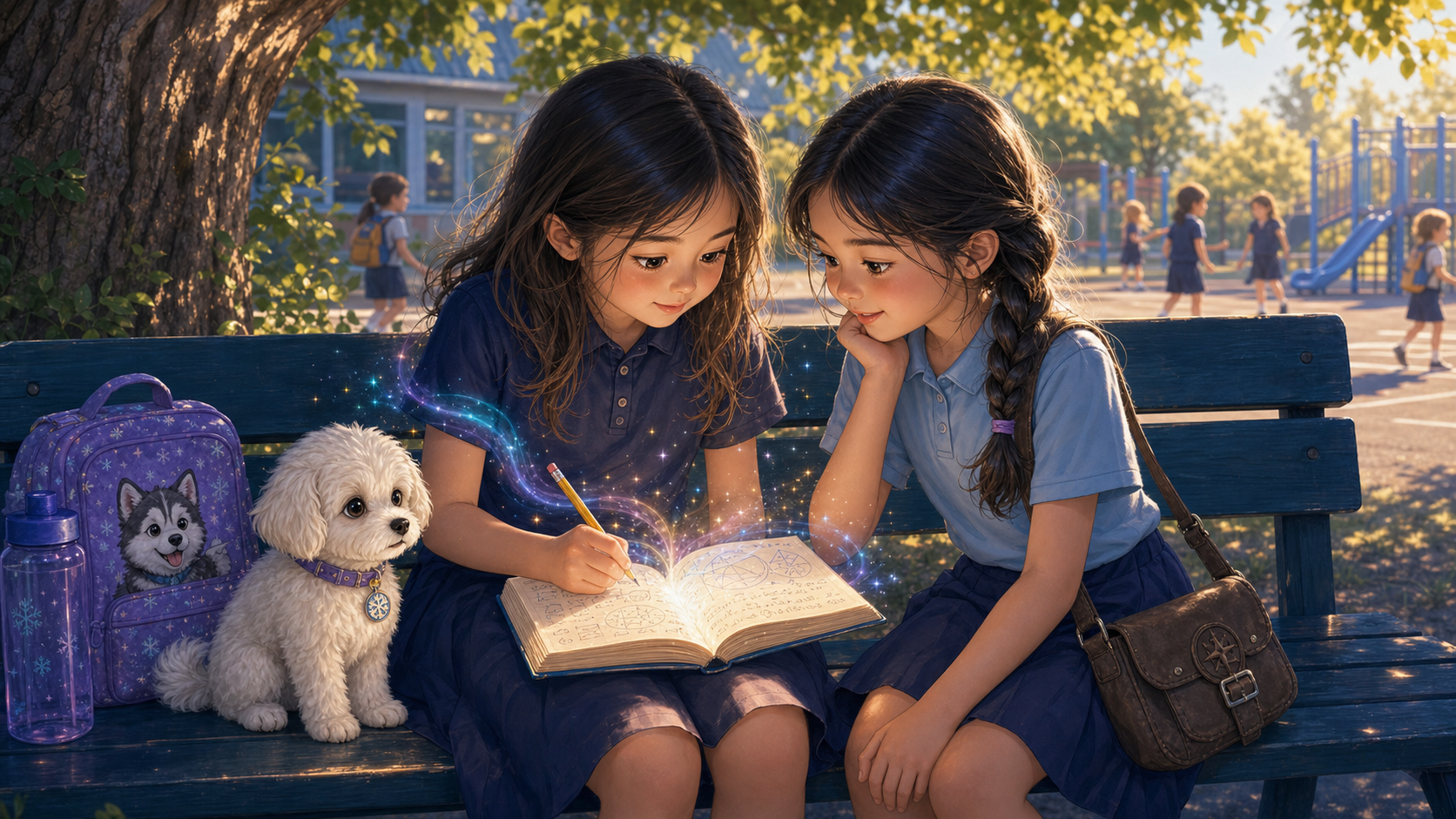
She did not look up at first. She had a notebook open. She was working through an integration that had been bothering her for two days, and she was almost there. She heard the soft creak of the bench under another person's weight. She heard a backpack settle. She heard a pencil come out.
Then she heard a voice.
"You used the wrong substitution on line eleven. If you let u equal x squared minus one, the integral collapses."
Sydney looked up.
The girl beside her was six, the same age as Sydney, with a long dark braid hanging over her shoulder and a face that did not have any particular expression on it. The girl was looking at the notebook the way a builder looks at a blueprint. Friendly. Interested. Not impressed. Just reading.
Sydney's first thought was that she was hallucinating.
Sydney's second thought was that it was a trick, and the girl was about to laugh and call her friends over.
Sydney's third thought, which came after a long careful look at the girl's face, was that none of those things were happening.
Sydney said, "How do you know that."
The girl said, "I do calculus too."
Sydney said, "You are six."
The girl said, "I know. Are you going to use the substitution?"
Sydney looked back at the page.
She rewrote line eleven. The integral collapsed.
She kept her eyes on the page for a long second, because she did not trust her face to do whatever it was about to do in a way she wanted a stranger to see.
When she looked up again, the girl was still there. Still reading. Still calm.
"Who are you," Sydney said.
The girl thought about it for a second. Then she said, "I think I'm your friend."
That was the strangest thing anyone had ever said to Sydney. She did not know what to do with it. She did not know how to be a person with a friend.
She said, "Why."
The girl said, "Because I have been at this school for four days and you are the only person who has not looked at me like I am background."
Sydney thought about that.
Sydney said, "I have been at this school since the start of the year and nobody has looked at me at all."
The girl said, "That sounds about right."
The bell rang.
They walked to the cafeteria together. Sydney bought a milk. The girl bought an apple. They sat at a round table that was usually empty. Sydney told the girl about Mersenne primes, because Mersenne primes had been in her head for a week and she had not had anybody to put them down with. The girl listened. The girl asked good questions. After a while the girl said, "Can I tell you something most people would not want me to tell them."
Sydney said yes.
The girl said, "Last weekend somebody taught me how to disable a car's electrical system in eighty-eight seconds, using only a paperclip and the right kind of patience."
Sydney said, "Show me how."
The girl took a paperclip out of her pocket. She unfolded it. She drew a quick diagram on a napkin. She walked Sydney through it.
Sydney said, "That is amazing."
The girl said, "Mersenne primes are amazing."
Sydney said, "Thank you."
The girl said, "You are welcome."
They walked back to their classroom together.
They walked back together every day for the rest of that week. And then the next week. And then the next. The girl's name was Penelope.
Penelope had a younger sister. Astrid was four then, and already loved by everybody who met her. Sydney did not have a sister. Sydney had Kyle, who was her younger brother, and a different but equally important kind of essential. Within a month Astrid was a third sister to Sydney, and Sydney was a second sister to Astrid. Within two months Kyle had wandered over for dinner with Sydney one night and just sort of stayed in the rotation. The four of them, plus the dogs as the dogs joined them over the years, became one unit.
In the second week of their friendship, at the lunch table, Penelope and Sydney made up a code-word for each other.
It was a nonsense word. They picked it because it sounded right. Neither of their families used it. Neither of their schools had heard of it. They wrote it on the inside of their lunchbox lids and never said it out loud unless they meant it.
It meant, I see you. I have always seen you. I will keep seeing you.
They had used it maybe a dozen times in their lives.
They had never used it without meaning it.
Sydney looked at Penelope.
Penelope looked at Sydney.
The cavern was coming apart above them. Astrid was on her knees now, both arms out, gold star-light pouring up out of her in a way Sydney had never seen, holding the ceiling by a margin Sydney did not want to measure. Kyle's beam was creaking and his arms were trembling. Boba's flame was a small bright halo around Astrid's feet, keeping the floor under her warm and solid. Omi was barking, sharp and steady, at a new crack opening on the far wall. Penelope's hand was the only steady thing in the world.
"It is not a number," Penelope said. Her voice was quiet under all the rest of it. "It is intent. The compass is a compass of intent. The sixth ring is not asking for math. It is asking us if we mean it."
Sydney did not say I do not know how to mean a thing into a piece of metal.
She did not need to say it. She knew, the moment Penelope said the words, what was being asked of them.
Sydney closed her notebook. She set it down on the floor at her knees, gently, like a thing that was tired.
She put one hand on the cryptex, palm down, fingers around the sixth ring.
Penelope put one hand on top of Sydney's. The other hand on Sydney's shoulder.
They looked at each other.
They said the word together. Once. Quietly. The same nonsense word they had written on the inside of their lunchboxes at nine years old. The word that had never left the two of them. The word that meant I see you. I have always seen you. I will keep seeing you.
The sixth ring slid into place under their fingers.
It did not click. It did not snap. It just settled, the way a thing settles when it has finally found where it is supposed to be.
The cryptex glowed once, soft and gold, the color of Astrid's star-light.
The wall behind it cracked open with the sound of a long-held breath finally being let go.
Echo burst out.
Echo did not jump on Astrid this time.
Echo was already at her side in a single bound, shoulder to shoulder, eyes forward, because Echo could feel the ceiling about to come down too. Echo had work to do.
The cryptex on the floor pulsed once more, then folded into itself, then was gone, leaving a thin ring of frost where it had been.
Whatever the cryptex had been holding up, it was no longer holding up.
The cavern began to come down for real.
A whole wedge of ceiling cracked free above the column behind Astrid. Astrid lifted her arms one final time and let go of every bell in her chest at once, all five of the small ones and the big one shaped like Echo, and a column of pure clean gold light went straight up into the falling ceiling and held it, just held it, for ten seconds.
"Run," Astrid said. "Run, run, run."
They ran.
Echo led.
She knew the way out. She had been looking at the cavern from the inside of the wall for hours. She had memorized the shape of every tunnel that branched off the central chamber. She turned hard left at the end of the chamber and the others poured after her.
Boba's flame ran ahead, lighting the tunnel.
Omi ran with his head low and his ears swiveled back and forth, calling out the cracks before they opened, barking once for left, twice for right, a long bark for the floor here is bad, jump.
Kyle scooped Boba up at a corner where the floor had given out completely and carried him under one arm.
Penelope grabbed Sydney's notebook off the floor of the central cavern at a full run on her way past, because Penelope would not leave Sydney's notebook to be buried in ice forever even if it cost her two seconds.
Behind them, the central cavern collapsed all at once. The sound was a deep low boom that they felt through their boots more than heard with their ears.
The tunnel ahead held.
Then it started to come down too.
Echo turned. Right. Down a slope. Up a steeper slope. Through a passage that narrowed to a crawl and then widened again. A patch of white sky overhead, getting closer.
Astrid was running with her hand on Echo's collar.
Sydney was running with Penelope's hand wrapped around her wrist.
Kyle was running with Boba clutched to his chest.
Omi was running flat-out beside Penelope, because Omi never went anywhere except where Penelope went.
The passage opened.
Cold air hit them.
They came out of the side of the mountain into open snow.
They did not stop running. They ran another twenty steps. Thirty. Then Echo stopped, and they all stopped behind her, panting, and turned around.
The mountain shook.
The opening they had come out of caved in. A long ripple ran down the slope, an avalanche of ice and stone collapsing into the spaces below the surface, and a deep boom echoed across the valley as the whole Skyglass system sealed itself.
It went quiet.
The Frostwild's wind moved gently across the new bare snow.
It was over.
Astrid sat down in the snow.
She did not mean to. Her legs just stopped working. She sat down hard. Echo lay across her lap and put her chin on Astrid's knee. The husky's eyes closed.
"I was wrong," Astrid said.
She did not say it loud. Everybody heard it anyway, because everybody had stopped moving.
"I thought," she said, "because Echo and I have powers, we had to do the biggest part alone. But that was not the real reason. The real reason was I was scared. I was scared that if I needed everyone, then I could lose everyone. So I told myself I did not. And I left you."
Boba padded up. He climbed into her lap on top of Echo, which Echo allowed, because Echo was very tired. He leaned against Astrid's chest.
"You can need everyone," he said, "and still be very impressive."
Astrid laughed. It was a small laugh and a tear-mixed one.
"Obviously," Kyle said. He was sitting on a rock with his coat unzipped now, the blood on his forehead drying, his arms shaking from carrying both Boba and the beam.
Penelope did not say anything. Penelope walked across the snow to where Sydney was sitting on a low flat rock, Sydney's notebook in Sydney's lap, both of Sydney's hands flat on the closed cover. Penelope sat down next to her, shoulder against shoulder. Neither of them spoke. Penelope took out a granola bar from her satchel. She broke it in half. She handed half to Sydney. They ate in silence.
Astrid watched them.
She had known, since she was five, that Penelope and Sydney were a particular kind of close. She had not known how close. She had not known about the bench. She had not known about the substitution on line eleven. She had not known about the code-word.
She thought, looking at them, that they had probably saved everybody's lives just now. And that they had probably saved each other's lives a long time before that, in ways she would never quite see.
She was glad for them. The glad sat quietly under her ribs, next to the bell.
After a while, Penelope stood up. She came over to Astrid. She bent down. She put her hand on Astrid's head, the way she had been doing since Astrid was four.
"You did it," Penelope said.
"We did it," Astrid said. She caught her sister's hand and held it, and did not let go for a while.
Above them, in the late afternoon sky, a faint shimmer of green-violet was already starting. The aurora of the Frostwild, watching.
Behind them, the Skyglass Caverns were sealed forever.
Ahead of them, on the next ridge, the high stone of the Observatory of Seven Moons rose against the sky.
They had a long way still to go.
But they were going together, all of them, the whole circle, and they were going on their feet, and Echo was alive and asleep across Astrid's lap, and Sydney had her notebook back, and Penelope had her sister's hand, and Boba had a clear conscience, and Kyle had survived by being Kyle, and Omi had not stopped listening.
The Frostwild was theirs to walk through.
They sat in the snow a little longer. Then they got up and started walking.
Chapter Five: The Observatory of Seven Moons
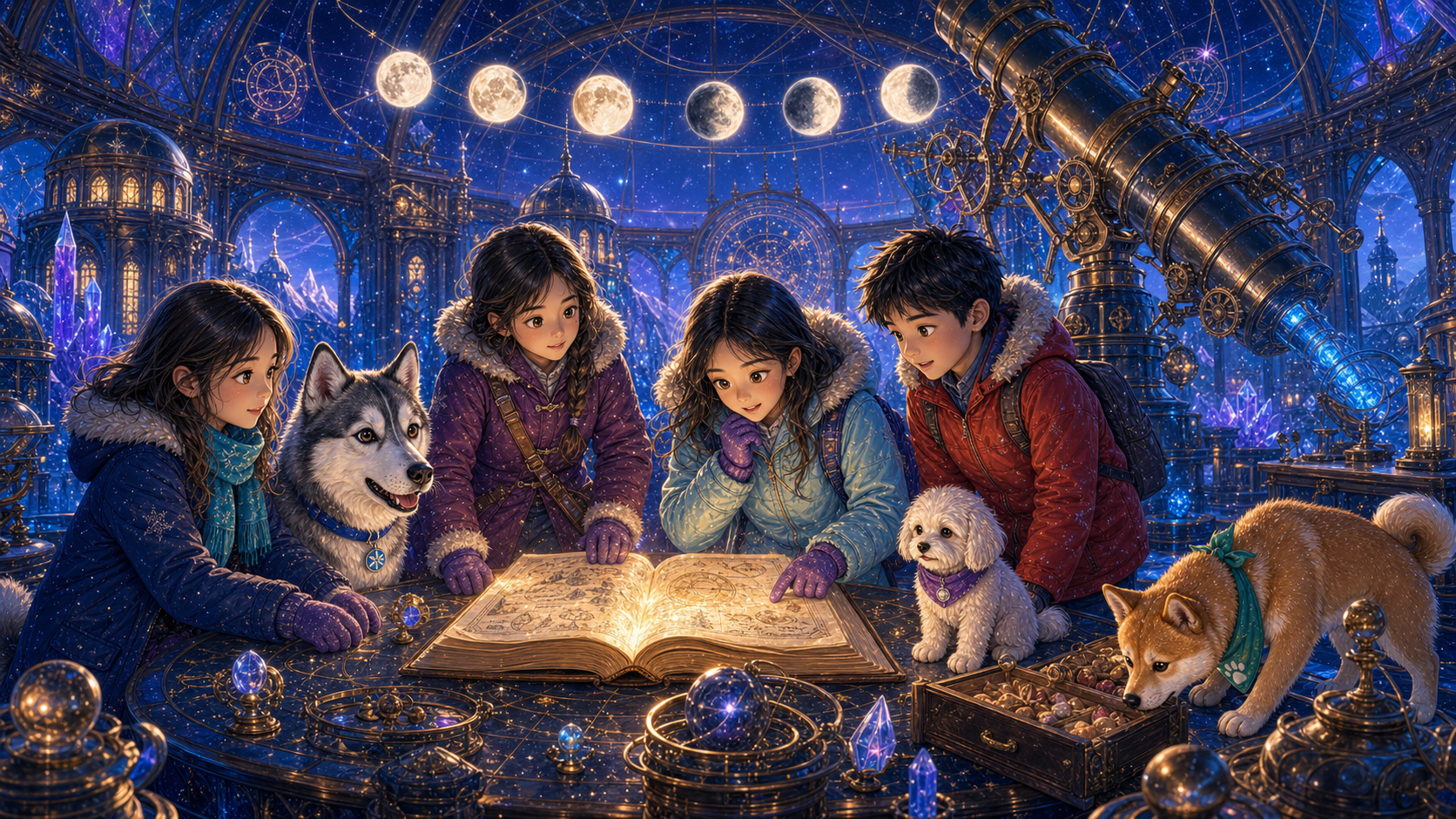
They left the Skyglass Caverns through a passage they had not come in by.
That was the way of the place, Sydney said. The Caverns rearranged. The way back was rarely the way you arrived. She made a small careful drawing in her notebook of the new passage as they walked, in case it mattered later. Astrid carried Boba for part of it, because Boba had used up a lot of dog on the rescue and his legs felt, in his words, like noodles. Echo walked very close to Astrid's hip and did not leave it.
The passage came out at a high cliff.
The cliff overlooked a valley they had not seen before. The valley was deep and dark, and at the far end of it, on a black rock outcropping that jutted out over a frozen river, stood a building.
They all stopped.
The building had three domes.
The domes were silver glass. They caught what was left of the daylight and threw it back in a hundred small specific glints. There were four towers around the domes, slim and dark, and connected to the domes by walkways that looked, from this distance, like spider silk. The whole thing should not have stood. It looked like a thing somebody had drawn on purpose to be lovely without paying attention to whether it could exist.
Sydney made a tiny noise.
"What is that," Kyle said.
"That," said Sydney, "is the greatest place I have ever seen."
"You have not been there yet," Penelope said.
"It will still be the greatest place I have ever seen," Sydney said.
The compass in Astrid's mitten pulled, gently, toward it.
So they went.
The walk down took an hour. The path was old and winding and at one point it crossed the frozen river on a narrow bridge made of black stone with no railing, which everybody crossed at exactly the speed of Boba, because Boba refused to cross any bridge faster than what he called a survival pace. By the time they reached the other side and started up the rock face toward the observatory, the sky had gone the color of a deep blue plum.
A row of seven small lights came on along the rooftop.
"The Observatory of Seven Moons," Penelope said.
She did not know how she knew. She knew.
The doors were not locked.
The doors were not even closed all the way. They stood open by an inch, the way somebody leaves a door for a cat, and when Penelope laid her palm against the wood, the wood pushed inward without resistance, and a soft warmth came out from inside, and the warmth had the smell of paper and old metal and clean stone.
Inside was a single great room.
The ceiling was a dome of dark blue glass, and through the glass the sky and stars showed as if they were being projected. In the center of the room, hanging in midair without any visible cord, were maps. Big ones. Slow-spinning maps of skies and lands, written over with lines and notes and small red marks like somebody's careful annotations. Around the maps, models of planets the size of grapefruits circled small blue flames. Each planet had its own pace. One went fast. One barely moved. One had rings.
Along the walls were drawers and shelves and instruments only Sydney and Penelope could name. A brass thing with three lenses. A silver wheel with seven spokes. A box of long thin glass tubes, each one full of a different color of mist.
In the very middle of the room, going down through the floor and disappearing into the rock, was a telescope.
It was huge. The barrel of it was as wide as a dining table. And it was pointed not up, at the sky.
It was pointed down.
Into the mountain.
Sydney walked into the room the way some kids walk into a candy store and others walk into a cathedral. She walked into it as if she had been waiting all her life to be in it without knowing she had been waiting.
"I am going to need," she said quietly, "more notebooks."
Boba, with his nose to the floor, immediately started circling. He was looking, he announced, for a snack room. The Observatory had to have a snack room. Every important place had a snack room. He would find it.
Penelope did not circle. Penelope started looking at corners.
Penelope's whole life was looking at corners. People hid the truth in corners. People hid plans behind paintings and journals under floorboards and important things under drawers that did not look like drawers. So she went around the great central table that held the spinning maps, and she ran her fingers along the underside of it, and on the third pass her fingers caught on a small wooden lip.
A drawer.
It was hidden so well that even she had almost missed it.
She slid it open.
Inside the drawer was a journal.
It was a thick journal. Leather. Cracked at the spine. The pages stiff with cold the way book pages get if they have spent a winter in an unheated cabin. There was no name on the cover, only the same kind of symbol that had been on the marker stone, carved deep into the leather: a five-pointed star inside a circle.
Penelope brought it to the central table.
They gathered around. Echo sat between Astrid's knees. Boba came back from his snack search empty-pawed and put his chin on Astrid's foot. Omi lay down at Penelope's side with his ears half-up, half-resting, the way they sometimes were when there was nothing dangerous nearby and he could allow himself to almost relax.
Astrid opened the journal carefully.
The handwriting was slanted and quick. The words were in their kind of letters, mostly, with the occasional symbol Astrid did not know. She read aloud, slowly, sometimes stumbling on a word.
The early entries were ordinary. Lists of supplies. Sketches of plants. A little drawing of a fox. The name Veyra appeared often, but lightly, the way a name appears in a journal when its owner is one of several friends. There were other names. Tomas. Helka. Brand. Mire. Small notes about who had cooked dinner. Who had laughed at whose joke.
Astrid turned the pages.
The entries went on for years. Veyra grew up in them. Veyra became, slowly, the cleverest of the team. Veyra learned to read the marker stones. Veyra learned to use the cracked compass before any of the rest of them. Veyra became, the journal said in the careful steady writing of somebody who loved their friend, our brightest. Our north star. The one we follow into the cold places.
Then the writing changed.
It got tighter. Faster. More urgent.
Veyra has gone after the Icebound Star during the white storm. We told her to wait. She would not wait. She said the storm was the only chance, that the wards would be weakest in it. We followed her signal as soon as the wind dropped enough to move.
Astrid's voice went quieter as she read.
The compass cracked. It must have. We have heard her voice in the wind, but the things it has been saying are wrong. She said we left her. We did not leave her. We are right behind her. We have been right behind her for three days.
Kyle had folded his arms.
The next page was harder to read. The handwriting was shaking.
We reached Starfall Hollow at dawn. There was no body. There was no person. There were only her tracks going in, and her tracks not coming out, and a very deep quiet. The compass on the central altar was gone. We searched until our lanterns ran out. We have rigged ropes for one more attempt tomorrow. We will not stop.
Astrid turned the page.
The next entry was in different handwriting. Smaller. Tighter.
We did not find her. We searched the lower hollow for sixteen days. We have left ropes anchored at every entrance in case she returns to find us. We have left her badge on the altar, polished, so she would know we did not abandon it. We are walking out today. None of us speaks of leaving. We are not leaving. We are stepping back so that she can step forward.
The last entry was just one line.
If you find this, and you know her, please tell her we waited.
There was a long silence in the Observatory.
The blue flames on the planet models flickered very softly. The maps overhead spun their slow patient spins. Somewhere in the room, one of the silver instruments clicked once, on its own, like a clock that had remembered it had a job.
Sydney had gone very still.
"Oh," she said.
Penelope had her hand flat on the journal page.
"She thinks her team abandoned her," Kyle said. "But they didn't."
"They tried to save her," Sydney said. "They came as far as anybody could come."
"And she has been here," Astrid said, slowly, working it out as she said it, "since then. With a broken compass. Listening to a wrong voice. For how long?"
"A very long time," Penelope said. She was not guessing. The leather of the journal told her how long. The dust in the corners of the Observatory told her how long. A thing in the careful set of her mouth told her how long.
Boba lifted his head from Sydney's foot.
"So," he said. He sounded thoughtful, which was a tone of voice that did not happen often with Boba. "So the bad guy is also sad."
"Sad can still be dangerous," Penelope said.
"I know," Boba said. "I am just keeping track."
Astrid closed the journal very carefully.
She put it on the central table beside the spinning maps. She kept one hand on it for a moment, the way you might keep a hand on the shoulder of somebody who has just said something hard.
"Okay," she said. "Okay. So we still have to stop her. She is doing a thing that will hurt the whole Frostwild. We cannot let her do that. But."
She looked up.
"We do not get to be cruel about it."
Sydney nodded.
Kyle, slowly, nodded.
Penelope said, "Agreed."
Echo stood up and shook out her coat and looked at the door.
Boba sighed. "I would have voted for cruelty," he said, "but I am willing to try the other thing."
Astrid laughed, despite everything.
She rested her hand on the leather one more time.
She turned to the door.
"Then let's go bring her home," she said.
Chapter Six: Starfall Hollow
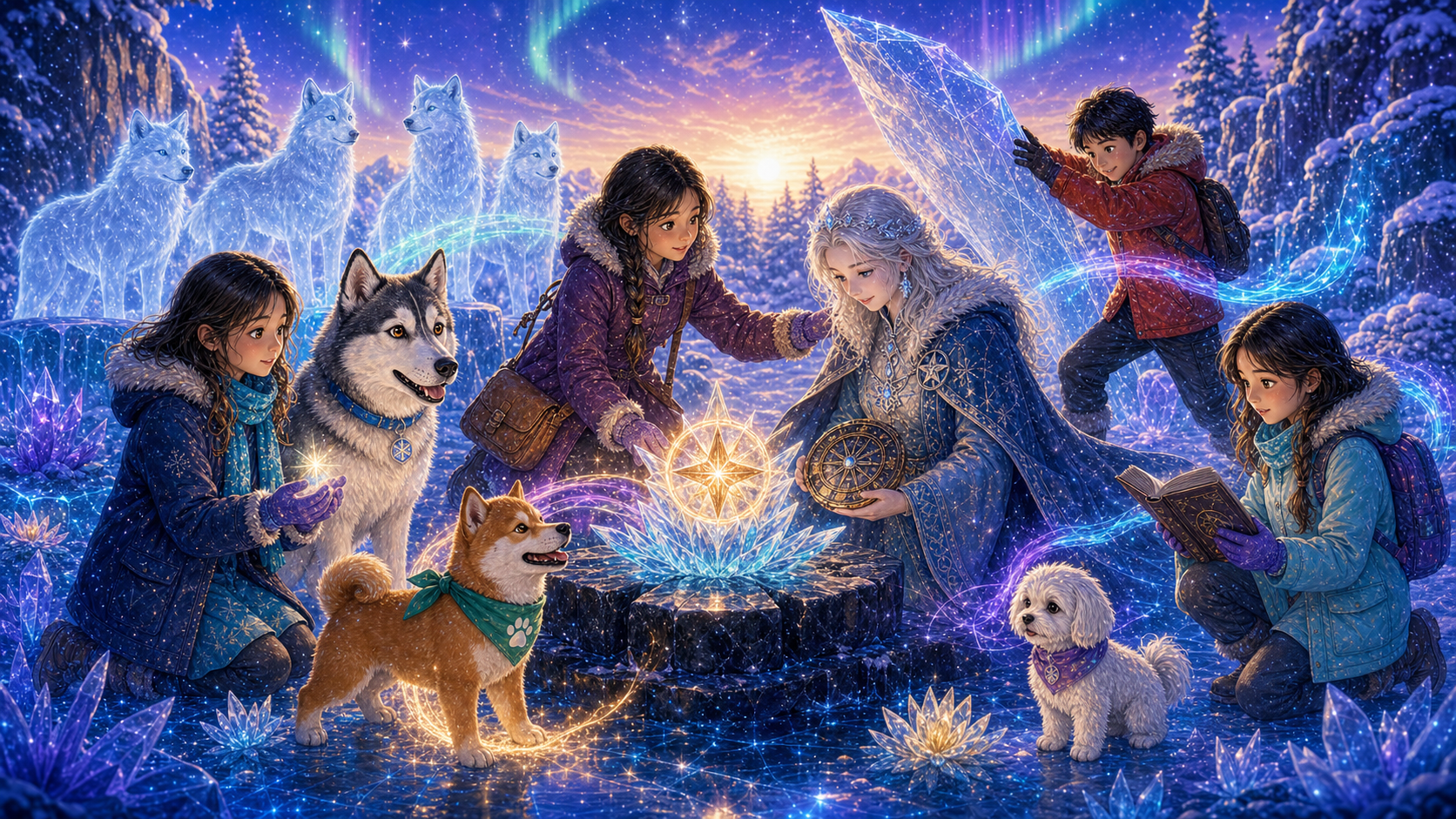
They walked through the rest of the night.
The compass led them down out of the Observatory's high rock and along a narrow ridge that wound around the side of the mountain. The wind here did not whisper. It did not have the energy. Whatever Veyra was doing now, it was happening somewhere ahead of them, and the closer they got, the more the world around them seemed to be holding its breath.
The lanterns of the pines were a long way behind them.
The sky overhead was deep dark blue with a stripe of green-violet aurora in it, low to the horizon, like the Frostwild was watching.
Astrid did not feel tired.
She should have. She had walked a long way. She had cried in a cavern. Her muscles had been wrung out twice and her heart once. But there was a thing happening in her chest that was not exactly the bell anymore. It was the bell, and it was five other small bells, and one bigger careful one shaped like Echo. They were all ringing together, gently, in time.
She walked at the front. She did not walk ahead.
Behind her, in order: Echo at her hip, then Penelope and Sydney shoulder to shoulder with Omi padding between them, then Kyle with Boba on his shoulders like a small disreputable scarf.
They reached Starfall Hollow just before dawn.
The hollow was a bowl in the earth at the base of the mountain. They came over the lip of it and stopped.
It was beautiful.
It was beautiful in a way that hurt to look at. The walls of the bowl were dark stone, but the floor was something else. Frozen flowers grew up out of the ground in clusters, hundreds of them, each one a different color, each one as still as if it had been carved. Under the surface of the ice, rivers of soft light flowed in lazy curves. A pale blue river. A pale violet one. A pale gold one. They moved slowly, but you could see they were moving.
In the very center of the hollow, on a low altar of black stone, stood the Icebound Star.
It was not as big as Astrid had expected. It was about the size of a small pumpkin. It was inside a clear crystal shell, and inside the shell it pulsed with a soft white light, as if it were breathing.
In front of the altar stood Veyra Frostveil.
Her cracked compass spun, wildly, in her hand.
She did not turn.
"You are too late," she said.
Her voice was thinner than it had been in the Lantern Pines. It sounded as if she had been talking to herself for a long time and had forgotten how voices were supposed to land in other people's ears.
The ice beneath the Star darkened, just slightly. The blue river slowed. A frost climbed an inch up the side of the altar.
Astrid stepped forward.
She did not raise her hands. She did not call her star-light. She just walked, slowly, across the ice and over the small frozen flowers, and stopped a careful distance from Veyra's back.
Astrid was three the first time she said something that scared an adult.
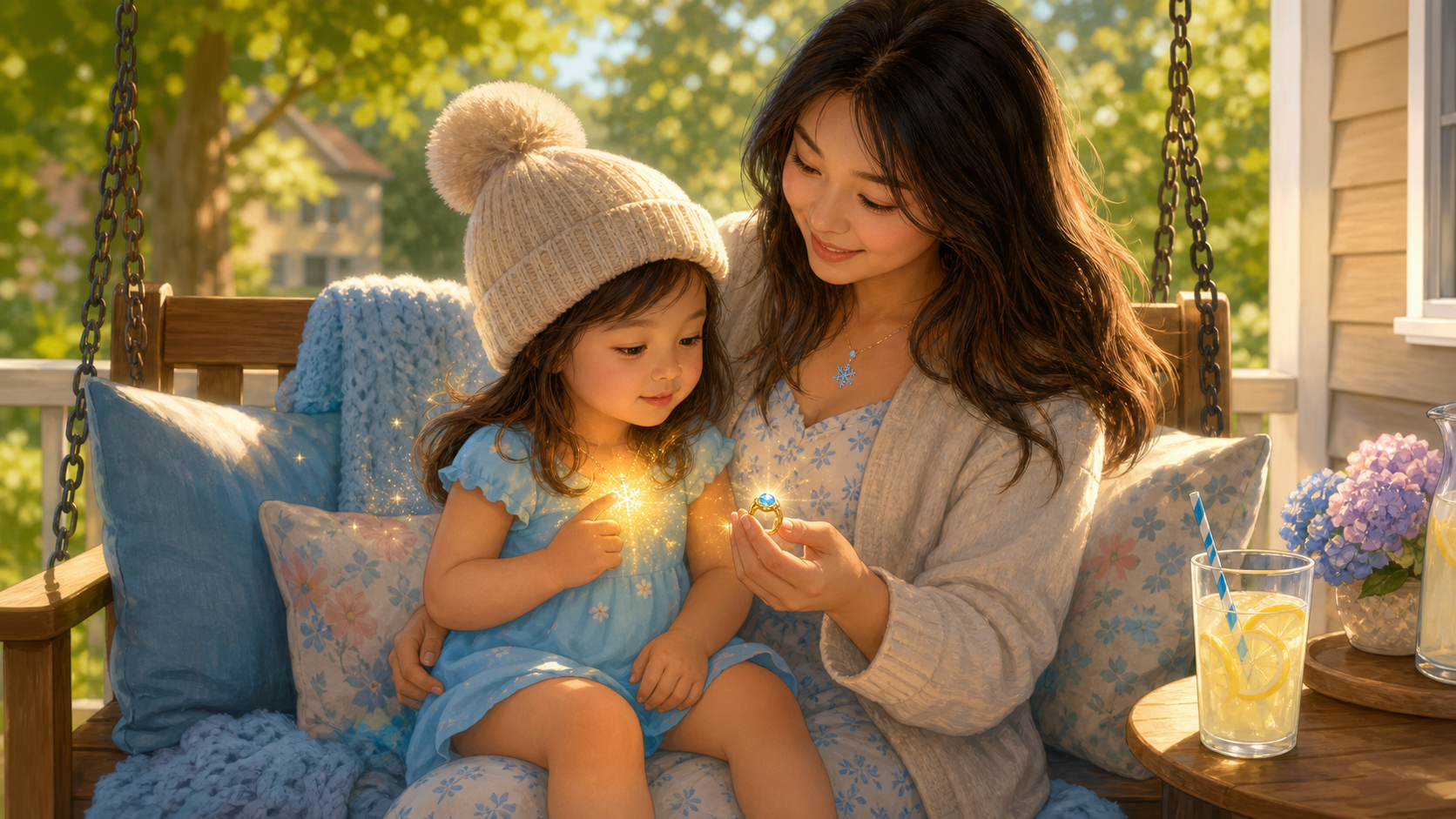
She was sitting on her aunt Catherine's lap on while visting her in Brooklyn. It was a summer afternoon. Aunt Catherine was rocking, slowly, the way she did. There was a glass of lemonade on the table beside them.
Astrid said, "Aunt Catherine. Your ring is under the cupboard in the bathroom."
Aunt Catherine had not been wearing the ring. The ring had been lost for two weeks. Niko, Harry -- Astrid and Penelope's cousins -- the whole family had been looking for it. Aunt Catherine had cried a little about it the night before, quietly, in the kitchen, when she thought everyone had gone to bed.
Aunt Catherine stopped rocking.
She said, "What did you say, kiddo?"
Astrid said, "Your ring. The gold one with the little blue stone. It's under the cupboard. The one in the bathroom. It rolled there when you washed your hands on Tuesday."
Aunt Catherine got up. She walked into the house. She came back two minutes later with the ring in her hand. She sat down on the porch swing again. She did not say anything for a long time. Then she said, "How did you know that, Astrid?"
Astrid said, "I just knew."
She did not know how else to explain it. She had felt the warmth in her chest, the soft little bell, and the bell had pointed her at the cupboard, and she had said the thing the bell told her.
Aunt Catherine had hugged her then. Hard. And had told Astrid, quiet, that maybe Astrid should be careful about saying things like that to grown-ups, because grown-ups did not always know what to do with kids who knew things.
Astrid was five. She did not understand. She tried to remember anyway.
It happened again. A lot. She knew when the dog at the park was about to throw up. She knew where her dad's missing iPad was after he had spent two days tearing the house apart looking for it. She knew when a thunderstorm was coming, two days before the weather forecast. She knew when her Au Pair, Sofia, was in love with Taylor, before Sofia had told anybody.
She was siz when she stopped saying these things out loud.
She was at school and she had told a kid named Tyler that his cat was going to die soon. She had said it because she had felt the bell. She had thought he would want to know. The cat had died three days later. Tyler's mother had called Astrid's mother on the phone, very upset. Tyler had cried for a week.
That was the day Astrid figured out that knowing was not the same as helping.
She stopped saying what she knew.
She did not stop knowing. She just kept it inside. She would feel the bell ring, and she would look at the person, and she would not say. She would carry the thing she knew, alone, in the warm spot under her ribs, and she would let other people find out their own way.
She got good at it. She got so good at it that the grown-ups stopped saying she was an old soul, because there was nothing visible anymore for them to point at. The kids her age stopped giving her that small space. She fit, finally, into the shape of a regular four-year-old.
But she was lonely in a way she did not have a word for.
She was a kid who saw things, and who could not say what she saw, and who therefore walked through the world holding a thousand small private pieces of other people's lives that other people did not know she was holding.
She was seven when that started to change.
Astrid had been carrying the bell for ten years now. She had learned, eventually, when to keep what she saw inside, and when to say it out loud. This was a moment to say it out loud.
"Your team did not leave you," she said.
For the first time, Veyra's hand on the compass flinched.
The compass did not stop spinning. But it skipped.
"Lies," Veyra said. The word came out flat.
Sydney came up beside Astrid. She had the journal held against her chest, both hands wrapped around it as if it were a small live thing.
"We read it," Sydney said. "We read what they wrote. They came after you. They reached the Hollow at dawn. They searched for sixteen days. They left their ropes anchored so you could find your way back."
Penelope took the next step forward. From inside her satchel she took out a small object, polished, silver. She tossed it gently. It skidded across the ice and stopped at Veyra's foot.
It was an explorer's badge. A five-pointed star inside a circle. The same symbol as the journal. The same as the marker stone.
"This was on the altar," Penelope said. "When they left. They left it here for you. So you would know."
Kyle pointed.
He pointed at the wall of the hollow, at a place high above their heads, where something pale and stiff hung in the rock. Old rope. Anchored there, into pitons hammered deep into the stone, a long time ago. There were three lengths of it visible from where they stood. There were probably more.
"They climbed all the way down here," Kyle said. "They left the ropes for you. They wanted you to be able to climb out."
Veyra's whole body had gone still.
She was not facing them. They could not see her face. They could see the line of her shoulder. The line of her shoulder was a thing that looked the way Astrid imagined a piece of paper looks the moment before it tears.
The compass slowed.
For one long second, the storm in the hollow softened. The frost on the altar paused. The blue river under the ice picked up a little speed.
For one long second, it might have all been all right.
Then the cracked compass made a sound.
It was not a click.
It was a scream.
It was a sound like a frozen lake giving way under somebody's weight, far away, all at once. The crack down the face of the compass widened. Blue fire poured out of it.
It poured everywhere.
It came up Veyra's arms and over her shoulders and around her like a cloak that had decided, on its own, to keep wearing her. It rolled out across the ice in waves. Where it hit the frozen flowers, the flowers blackened. Where it touched the rivers of light under the ice, the rivers stopped.
Ice-shadows erupted.
They were bigger this time, and worse, and less shaped. A rolling lake of cold blue mist with the suggestions of teeth and limbs and faces, all moving wrong. They climbed the walls of the hollow. They covered the ceiling of the sky.
"She cannot control it!" Sydney shouted.
Above them, the rock face of the hollow cracked.
A sheet of ice the size of a barn door peeled off the wall. It fell. Penelope, who had been the closest to it, looked up just in time to see it coming and just slightly too late to move.
Kyle moved.
He did not think first. He went under. He braced his shoulders. He caught the sheet of ice across his back and his shoulders and his upthrust hands, and his knees buckled, and he held it.
Kyle was two and a half the first time he picked up something he should not have been able to pick up.
He was in the living room. His mom Felicia was reading a book on the couch. His mom Amy was on a video call with someone in another country, in her uniform, her voice steady and low. Kyle was supposed to be playing on the rug.
The kitchen chair was in the way of a Lego project. Kyle wanted the kitchen chair to be somewhere else. Kyle was two and a half. Kyle did not have the vocabulary to ask for help.
So Kyle reached out, gripped the leg of the kitchen chair in his small fist, lifted it, and walked across the living room with it dangling from one hand. He set it down by the bookshelf. He went back to his Legos.
Felicia had stopped reading.
Amy had said into her video call, "Hold on a moment," and turned to look at her wife, and her wife had pointed silently at Kyle, and the chair, and Amy had gone very still.
Kyle, two and a half, did not understand why the room had gone quiet.
He learned over time.
By four, he had figured out that he was strong in a way other kids were not. He could push the swing-set crossbar straight up out of its concrete footing if he put his shoulder against it, and he had done so once, on a dare, and had been mortified by the look on the playground monitor's face. He could lift his mom Felicia, gently, in a hug, with one arm. He could open the pickle jar that his mom Amy could not open.
This was, mostly, a good thing.
It became a less good thing in tag.
He pushed a kid named Oliver during a game in preschool. He had not pushed hard. He had pushed the way a normal four-year-old pushes another four-year-old, lightly, with the side of one open hand. Oliver had flown. Actually flown. Three feet through the air. He had landed on the woodchips and skinned his elbow and started crying, and the teacher had run over, and Kyle had stood there with his hand still half-extended, frozen, because he had just learned, in a single second, that what he meant did not matter as much as what he could do.
Oliver was fine. He was back at school the next day. But Oliver did not play tag with Kyle anymore. And then Kyle stopped playing tag, because he had decided, quietly, that he was a kid who was dangerous to be near.
He started holding everything back.
He let other kids win at tug of war, at arm wrestling, at the rope climb in gym class. He carried his backpack as if it were heavy, even though it was not. He hugged his parents the way a normal four-year-old hugs, light and careful, and his moms knew, and they did not say anything, because they did not know how to.
He thought about himself the way the playground monitor had looked at him, frozen in mid-air with his hand still raised.
He was four when he started thinking it might be better to not touch anybody at all.
He was four when Sydney's family found Astrid and Penelope's family.
Kyle had been holding things back his whole life. Now, with the cavern coming down on his friends, he was holding something up with all of it.
"Move!" he yelled.
Penelope rolled out. She rolled across the ice and did not stop rolling until she was clear, and then she came up on her feet already running for the next thing that needed to be done. Six years of figure skating taught a person to fall correctly and stand up faster than seemed reasonable. Penelope had been doing it since she was four.
Another crack opened in the floor of the hollow, near Sydney.
It was a thin crack, but it widened fast. Sydney's foot went through. She caught herself on her elbows. Her notebook flew from her hand.
Boba sprang.
He was off Kyle's shoulders before Kyle had finished bracing. He landed near the crack with his small paws planted, and golden flame burst from him in a clean bright wave, into the ice between Sydney and the widening hole. The flame did not melt the ice. It softened it. It made a shelf, the way warm hands soften clay, and the shelf held Sydney's elbows long enough for her to scramble out, which she did, scraping her knee and not caring.
"Thanks," she gasped.
"Snacks later," Boba said. His voice was tight. He had the flame still going. He was concentrating.
He did not see the frostwraith come up behind him.
It came over his shoulder, long and cold and wrong. Boba had his eyes on the ice. He was holding the shelf for Sydney, and he was already preparing to hold the next thing that needed to be held, because that was the kind of dog Boba had decided to be. He did not see the long blue limb come over his back.
Sydney saw it.
"BOBA!" she screamed.
Boba turned his head a quarter inch. The wraith struck.
It hit him across the back like a hammer made of cold. His golden flame guttered, and went out. His small body skidded across the ice and stopped against the base of the altar, and he did not get up.
Kyle made a sound.
It was not a yell. It was not a word. It was the sound a brother makes.
In the air of the hollow, the ice-shadows tried to braid themselves into a wall around the altar.
They tried to wall the Icebound Star away forever.
A second wraith broke off from the wall and came across the ice toward Penelope, who had her back to it, who was looking at the silver badge at Veyra's foot.
Omi saw it.
He had stepped a yard from Penelope's heel a moment before, to listen at a small new crack on the far wall. His ears had been turned toward the crack. The wraith came at Penelope from the other direction, fast.
Omi was faster.
He did not bark this time. There was no time to bark. He turned in midair and covered the distance between Penelope and the wraith in two long bounds. His small curly body collided with cold blue mist. The wraith broke around him and reformed, and Omi fell, and he hit the ice on his side, and he did not get up.
Penelope turned just in time to see him land.
"Omi," she said. She had said many things in her short life as a CIA case officer in unofficial cover. She had not, until this moment, ever said anything that came out of her quite like this.
She ran to him.
Echo was the one who broke the wall.
Echo ran. She ran up a ramp of falling ice as if the falling ice were a staircase, and she sprang from one shard to the next, four-pawed and balanced, and she came down on the altar's far side and turned and faced the wall of shadow and lifted her head and howled.
The howl was the loudest yet.
It punched a hole through the shadow wall.
But on the altar's far side, where Echo had landed, more wraiths poured up out of the ice. They came at her from every direction. Five of them. Six. They did not have a shape that Echo could fight with her teeth. Echo fought anyway. She lunged at faces that were not faces. She bit at mist that closed back together. The wraiths covered her like cold water closing over a stone.
Astrid screamed.
She ran through the broken wall, star-light streaming from her hands, and she came up to the altar, and she came around to the far side, and what she saw stopped her breathing.
Echo was lying on the warm stone of the altar.
On her side. Eyes open. Chest barely moving.
Astrid dropped to her knees.
"No," she said. "Echo. No."
She put both her hands on Echo's coat, the cream-and-woodsmoke coat, and the coat was still warm but not warm enough. Echo's brown eyes shifted slightly. Echo's tail twitched, just once. A small last polite acknowledgment that her girl was here.
Astrid was crying.
It was not the crying she had done in the cavern. That had been the crying of a kid who was scared. This was something else. This was the crying of a person whose whole heart was leaving the room and could not be stopped.
The bell in her chest rang. It rang very faint. It rang the message that Echo was still here, was holding on, was holding the thinnest thread, and that the thread would not hold long.
Astrid looked up.
The hollow was a battlefield. Kyle was still under the falling ice door, his arms trembling violently and his face white because he could see, across the floor of the hollow, his small russet dog Boba motionless against the altar's base. Sydney was running across the ice toward Kyle, the journal clutched against her chest, her hair wind-tossed and her face wet with tears, calling, "Kyle, hold on, I'm coming, hold on." She reached him. She got under the ice door beside her brother and put her shoulder against the inside of his shoulder. The door did not fall. Kyle whispered, Boba. Sydney whispered back, I know. I know. Hold the door. Just hold the door.
Penelope was on her knees beside Omi. Both her hands on his small chest. Her fingers pressing and releasing, pressing and releasing, in the rhythm of a person who had been trained to keep a body alive while help was on the way. Her face was wet. She was not making a sound.
Veyra had stopped attacking.
She was standing at the altar now, the cracked compass in her hand, and she was watching, and she was not moving.
"Sydney," Astrid called. Her voice cracked. "Sydney. The journal. Is there. Anything. About this."
Sydney's hands were shaking. She had the journal open against her thigh, against the inside of her brother's coat, while her shoulder kept the door up. She turned a page. Another. Another.
She stopped.
"There's a rite," she said. "I read it once. I didn't understand it. I thought it was a metaphor. It's not."
"Read it," Astrid said.
Sydney read it through her tears.
"The Frostwild Rite of First Breath. What loves you can be called back, but only if all who love it are willing to give what is most theirs. The rite needs four givers. Light. Word. Touch. Strength. The rite cannot be performed for any other reason than love."
"Four givers," Astrid said.
"Three receivers," Sydney said.
"That's us. That's Boba, Omi and Echo"
"Yes."
Astrid looked up.
She looked at each of them. Each of them. Not behind her. With her.
Astrid had been six for two weeks when she first met Kyle.
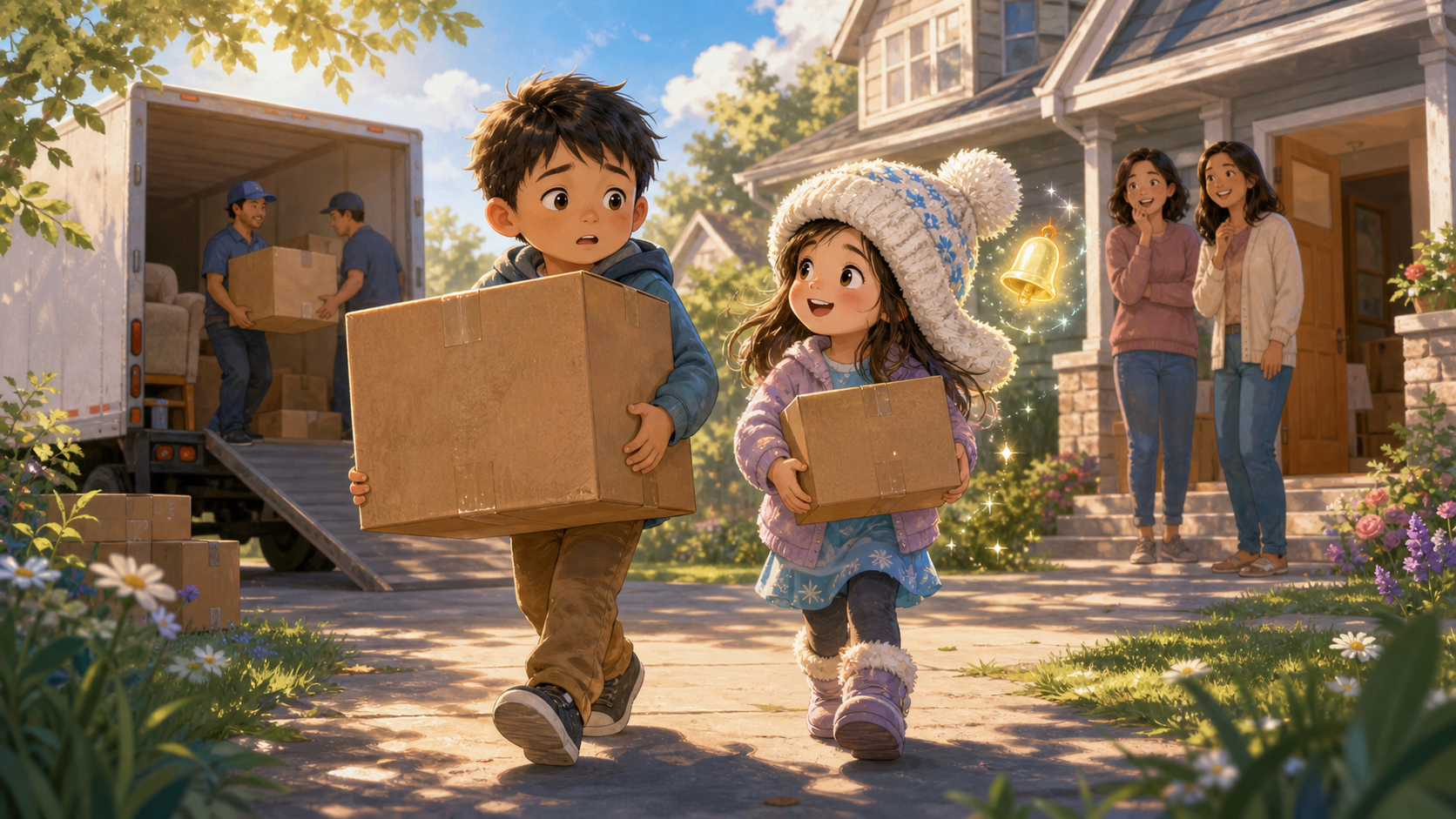
She was on her own front lawn. She was wearing a hat with a pompom on top that her aunt had knit too big and which Astrid loved exactly because it was too big. Her mom was inside. Her dad was inside. Penelope, was at the kitchen window watching, waiting for her new Sydney to come over.
There were two moms. One in a cotton tank top, dark short hair. The other in an Army PT shirt and shorts, her hair a little bit longer but kept Army-style.
And there was a boy. Kyle
The boy was about Astrid's age. He was small. And he was carrying an entire moving box.
The box was much, much bigger than the boy was.
Astrid watched him carry it across the lawn. He was carrying it the way you would carry a small bag of groceries. Not straining. Not even slow.
Astrid felt the bell.
She felt it ring loud and clear and warm, the way it had rung the day her aunt Catherine's ring had been under the radiator. It was not pointing her at a hidden object this time. It was pointing her at a kid.
She walked across the strip of grass between the two yards.
The boy looked up.
He had brown eyes. He had a careful face. He looked, Astrid thought, like a kid who was used to being watched in a way he did not like.
She said, "What's your name?"
He said, "Kyle."
She said, "I'm Astrid. Why did you stop carrying the box?"
He said, "I shouldn't carry the big ones."
She said, "Why not?"
He said, "Because. People get weird. When I do it."
She thought about this for a second. She squatted down by the box he was sitting on, so they were at the same height.
She said, "Is it heavy for you?"
He said, "No."
She said, "If it's not heavy for you, why does it matter what other people think when you carry it?"
He looked at her.
She did not have an answer for him. She was six. She had only the bell, ringing, telling her this kid was good and was hurting. She had only the question.
He said, slowly, "I don't know."
She said, "Want to keep carrying boxes?"
He said, "Yes."
She said, "Can I carry the small ones?"
He said, "Yes."
He stood up. He picked up the big box he had been sitting on. She picked up a smaller box from the flatbed truck where her dad, Pods, had been recieving material for the shed, because that's how long it to took build that damn thing... like AGES.
They put the boxes down inside.
They went back out. Kyle picked up another big box. Astrid picked up another small one. They went back inside. They went back out. They worked alongside Pod's and Kyle's moms for the next forty-five minutes. Nobody said anything.
Kyle's mom Amy paused, once, between trips, to watch them. She caught Astrid's eye. Astrid did not look away. Amy did a tiny smile that was not quite a smile, and went back to the truck.
That night, at dinner, Astrid told her mom and Penelope, "Kyle is worried that he's too strong."
Her mom looked at her. Her mom had been getting used to Astrid's knowing for four years. Her mom said, "Is he?"
Astrid said, "Yes."
Pod's said, "Is he too strong?"
Astrid said, "Yes. But that's not the bad part. The bad part is he thinks it makes him bad to be near. It doesn't. He's good. I'm going to keep going over there."
Her mom said, "Okay, Astrid."
Penelope, looked up from her plate. She had been quiet during the whole dinner because she had been processing the new neighbors with her own kind of careful attention. She looked at Astrid. She said, "The older girls is Syney and is going to be my best friend."
Astrid said, "I think so too."
The two sisters had locked eyes across the table for a second. Then they had gone back to their food.
The next morning, at six thirty, Astrid was in her front yard with a small wagon she had loaded up with tools. She was four. The tools were hers from the garage: a hammer she could barely lift, a tape measure, three colored markers, a roll of painter's tape, and a granola bar. She had decided overnight, in her own four-year-old way, that she was tired of how long it had taken Pods to build the shed. She did not have a clear plan. She just had the wagon.
Kyle was in his front yard. Kyle was alone. Kyle had not slept much. He had a box in his hands that was so light it was almost insulting. He was holding it as if it were heavy.
Astrid said, "Hi Kyle."
Kyle said, "Hi Astrid."
She said, "You can stop pretending to lift the light box."
He looked at her.
He set the light box down.
She said, "Want to help me build an IMF club in our backyard? I have tools."
He said, "Okay."
They built the club. In much less time, as they both like to tell everyone, than Pod's was going to take.
It took two weeks. The fort was not a very good fort, because a six-year-old and a fsix-year-old, even working together, even with the six-year-old who was strong, are not master craftsmen. But the fort had a real door, and the door swung open and shut, and the fort had a roof that did not leak in the rain, and the fort had a sign Astrid had drawn that said IMF HQ in three colors.
Kyle's strength was useful in the fort. Astrid's heart was useful in the fort. By the end of the two weeks, when Kyle's moms looked out the kitchen window with Pod's and M, and saw their son swinging a hammer at a doorframe with a focus he had not had since he was two, they had each separately and silently cried, very briefly, into a kitchen towel.
That was the start.
The bell in Astrid's chest had been pointing her at people her whole life. It was pointing her at all of them now.
"Everyone together," she said.
It was not a shout. It was not a war cry. It was the same quiet voice she had used to speak to the wall of the cavern. I am here. We are all here.
The bell in her chest swung, full.
Star-light rose out of her, but this time it did not stay in her hands. It rose up the rock walls of the hollow. It found the cracks above Kyle's head, the falling ice door, the broken places. It poured into them. The door, which had been sliding under the weight of two children, caught and held. The hollow itself was holding the door now.
"Kyle," Astrid called. "Let go. Come help me bring them back."
Kyle let go.
The door did not fall. The hollow held it.
Kyle ran. Sydney ran with him. They came around the altar and dropped to their knees beside the place where Boba lay against the altar's base. Sydney lifted Boba's small body, careful as a thing she had loved her whole life, and carried him to where Astrid knelt.
Penelope had not moved from Omi's side. But she lifted her face and met Astrid's eyes across the hollow.
"Bring him," Astrid said.
Penelope, gentle as she had ever been, slid her arms under Omi's small body and carried him to the altar. She laid him down beside Echo on the warm stone. Sydney laid Boba on Echo's other side.
The three dogs lay together in a careful row.
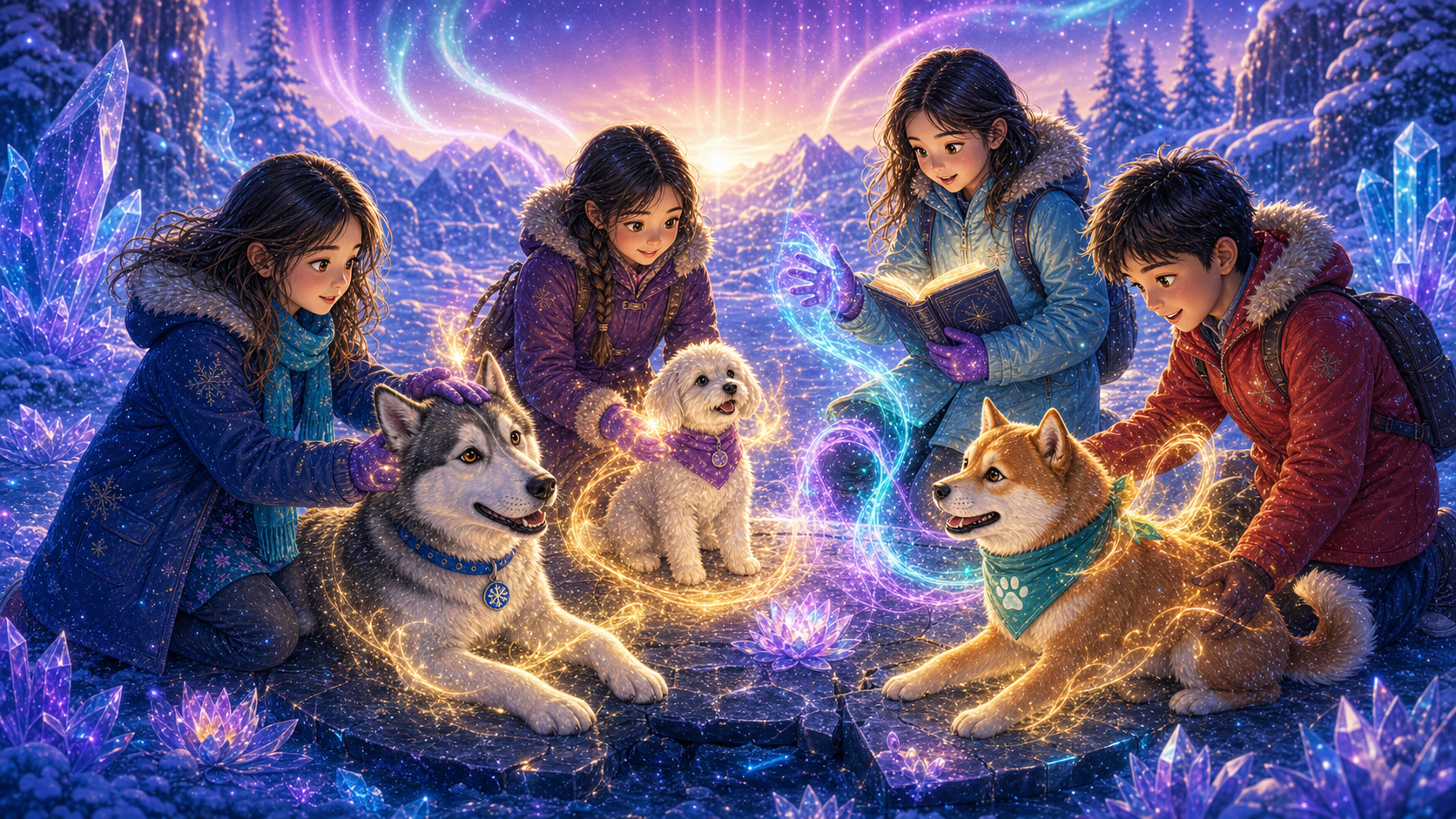
Sydney opened the journal flat on the stone. She put her hand on the page that held the rite.
Astrid put both her hands on Echo's chest. Penelope knelt at Astrid's left shoulder, Sydney at her right. Kyle knelt across from Astrid, on the other side of the dogs.
"Light," Astrid said. "I have the light."
"Word," Sydney said. "I have the word."
"Touch," Penelope said. "I have the touch."
"Strength," Kyle said. "I have the strength."
Astrid said, "Then begin."
Sydney read the rite aloud.
It was an old prayer. The Frostwild's. She read it slowly, the way Veyra herself might have read it once, when Veyra had been a young explorer who still loved her team. She read it as if every word mattered, because every word mattered.
She named the dogs.
"Echo. Boba. Omi. Come back. We see you. We need you. Come back."
Astrid poured.
The bell in her chest opened, all the way, in a way it had never opened before, and the warmth that had always lived under her ribs flowed out through her hands into Echo's chest. It was a star-light gold. It did not glitter. It did not shimmer. It just glowed, soft and steady, the color of the Star itself.
Penelope's two fingers pressed against Omi's breastbone in the rhythm of the rite. Pressing and waiting. Pressing and waiting. The field-medicine touch she had learned in a cold gymnasium in Virginia the year she was six, the year her gift had still been scary to her. The first time it was not scary now.
Kyle's hands held the small ribs of Boba and Echo and Omi together, all three at once, the way a careful older brother carries something his small sister loves. He was not gripping. He was holding. The strength he had been holding back his whole life was no longer for breaking. It was for keeping things whole.
Sydney's voice did not stop.
The light from Astrid's hands traveled.
It traveled along her wrist into her own arm, up her arm into her shoulder, across her back to where Sydney's shoulder was leaning against her, and from Sydney's shoulder into Sydney's hand on the rite, and from the rite into the dogs through some connection Astrid did not understand and did not need to understand.
It traveled the other way too. Into Penelope's shoulder. Down Penelope's arm. Through her two fingers on Omi's breastbone.
It traveled through Kyle. The strength under the small bodies became a steady unbreaking thing, and the thing flowed from Kyle's hands into the bones of all three dogs at once.
The four gifts wove together.
Light. Word. Touch. Strength.
They became a single bright cord, the color of dawn coming up over a winter horizon, and the cord poured into Echo and into Boba and into Omi all at once.
The hollow went very quiet.
Echo breathed.
Her ribs lifted. Her chest filled. She drew in a long deep breath as if she were breathing for the first time in her whole life, and the warmth came back into her coat.
Boba breathed.
His small chest rose. He coughed, once, weakly. Then again, stronger.
Omi breathed.
His ears, which had been flat against his head, lifted. Just barely.
Astrid did not move her hands.
She was sobbing, openly, without trying to stop. Tears dropped onto Echo's fur. Echo's brown eyes opened. Echo found her girl. Echo's tail moved. Once. Then twice. Then a small uncertain wag.
"Hi," Astrid whispered. "Hi. Hi."
Echo licked her hand.
Boba lifted his head a quarter inch. He looked at Sydney. He looked at Kyle.
"Did I get the snack," he said. His voice was croaky. It was the voice of a dog who had been gone for a minute and had come back not entirely sure why. The voice was Boba's voice.
Sydney made a sound that was half a laugh and half a wail and put her face down against Boba's chest.
Kyle did the thing he had not done since he was two years old. He hugged Boba with both arms, not gentle, not careful. He hugged Boba like he meant it. Boba grunted, surprised, and then leaned into the hug.
Omi pressed his head into Penelope's palm.
Just like always.
Penelope, who never cried, who had been trained out of crying by men in gray coats long ago, cried then. She cried silently, the way she did everything silently. She bent her forehead to Omi's forehead. She did not move for a long time.
The light from the rite did not stop when the dogs came back.
It rose.
It rose out of the dogs the way steam rises off warm bread, and it spread across the floor of the hollow, and it went up the walls, and it touched everything cold.
The frostwraiths flinched.
Whatever Veyra had bound into them, whatever cold thing she had layered over them across the years, could not stand up to four children pouring love into three dogs in front of it. The thing that had been holding the wraiths in their wrong shape was a lie. The rite was true.
The wraiths broke.
They did not break into shards. They drifted, briefly, as a thin blue mist.
But the mist did not vanish.
It was settling.
It was settling onto shapes, real shapes, on the floor of the hollow, where moments before there had been only stalking horror. The shapes shrank. The shapes found their fur. The shapes lifted heads that were heads now, real heads, with real eyes and real ears and the careful breathing of real living animals.
They were wolves.
Seven of them. They were dust-gray and snow-white, and one was the deep red of a fox in autumn. Their breath made small clouds in the warming air. Their eyes were dark and clean. They stood, where the frostwraiths had been, and they looked, briefly, dazed, the way a person looks when they wake up in a chair they had not meant to fall asleep in.
Astrid heard her own breath catch.
These were not wolves she knew. But Echo knew them.
Echo had not barked at the frostwraiths in the Lantern Pines. Echo had not barked at the frostwraiths in the Caverns. Echo had not barked at the rolling tide of cold blue mist a few minutes ago, either. Astrid understood now, the way you understand a riddle the moment somebody says the answer. Echo had not been barking because Echo had known. Some part of Echo, the part of her that had been a wolf before she had been a dog, had known all along that the things attacking them were not what they pretended to be.
The largest wolf, the one with the deep red coat, took one careful step forward.
Echo did not move.
The red wolf came across the ice, slow, head low, the way you approach somebody you have not seen in a long time and are not sure will recognize you. He stopped two steps from Echo. He waited.
Echo touched her nose to his nose.
The red wolf made a small sound. It was not a howl. It was the sound a wolf makes that means I see you, sister. Echo answered. The other six wolves came forward then, all at once, careful, and they pressed their heads briefly to Echo's flanks and her shoulder and her back, the way kin greets kin after a long parting.
Astrid felt the bell in her chest ring a long bright note.
"Veyra," she said, quietly. "These were yours?"
Veyra, on her knees on the warm stone, was looking at the wolves with her hand over her mouth.
"They were not mine," Veyra said. The words came slow. "I had thought them mine. I had told them they were mine. The compass had told me, and I had told them, and they had believed me because they had nothing else to believe." She pressed her palm against her cheek. The lines around her eyes deepened. "They were the Frostwild's. They were Echo's tribe, from the high snowfields. They were never mine to take."
The red wolf turned his head. He looked at Veyra. He did not bare his teeth. He looked at her the long quiet way wolves look at things, weighing.
Then he padded over and lay down beside her. Not at her feet. Beside her. The way a wolf lies down by another wolf when the long cold is over.
The other wolves followed his lead. They settled in a careful half-circle, some near Veyra, some near Echo, all easy now, all home.
Boba whispered, "I am not going to lie. I was a little scared of those guys."
"They were scary," Sydney whispered back.
"They were corrupted," Penelope said. Her voice was low, careful. "She bound them. Probably one at a time. Over a long period of time."
"Years," Veyra said. The word was a confession.
Echo lifted her head and made a sound that was not quite a howl. It was a clean clear note, the kind huskies make when they are talking to other dogs from far away and want to be sure they are heard. Six other throats lifted. Seven wolves and one husky sang, briefly, into the dawn light of Starfall Hollow, and the sound went up the rock walls and out the open top of the hollow and into the sky of the Frostwild.
Omi heard them first.
He was the only one who heard them at first. His whole body went still, ears up at full attention, head tilted toward the open sky. Penelope saw him do it and dropped to a knee beside him and put her hand on his back. What do you hear? she asked.
His tail moved once, slow, the way it moved when he was hearing something good.
A few seconds later, Astrid heard it too. Then the others. Far away, up in the high snowfields and out in the deep places of the Frostwild, other voices were answering. Wolves they could not see. A long careful chorus, faint, real. Other family, hearing their family was free.
Then it was quiet again.
Veyra was still on her knees on the warm stone. The cracked compass was still in her hand. The blue fire was no longer pouring out of it. The rite had quieted that. But the crack down the face of the compass remained.
She looked at it.
She held it out, palm up. "I do not know what to do with this," she said. "I do not know what it is now."
Astrid stood up from where she had been kneeling beside Echo. Echo, weak but standing too, leaned against her leg. Astrid pulled the small blue crystal compass from her mitten. The one that had appeared in her yard. The one she had carried all this way.
She walked across the warm stone toward Veyra.
"I think this was always meant for you," Astrid said. "It was waiting for somebody. I think it was waiting for you."
Penelope crossed the hollow to stand at Veyra's other side. She held out her hand, careful. Veyra surrendered the cracked compass to her.
Astrid handed Penelope the crystal needle.
Penelope, gentle, as if working with the frame of an old photograph, slid the crystal needle into the crack of Veyra's compass.
It fit.
Of course it fit. That was why the crystal had appeared in Astrid and Penelope's yard, on a day when Sydney and Kyle would be there. It had been waiting. It had been the missing piece for a long time. Not for the rite. For Veyra.
The compass sealed.
Penelope handed it back. Veyra held it against her chest with both hands.
The crystal shell around the Icebound Star opened.
It did not shatter. It opened, like a flower, in six clean petals of clear ice, and they fell away and lay in a careful ring around the altar, and the Star inside lifted, slowly, up into the air above the hollow.
It was small and round and pale gold.
It was the morning.
It poured dawn into Starfall Hollow. The frozen flowers, the ones that had not blackened, took on color, real color, every shade somebody might want a flower to be. The blue river under the ice ran fast and clean. The black stone of the altar warmed. The old rescue ropes in the rock face glowed faintly, just for a second, an acknowledgment.
Veyra Frostveil bowed her head over the sealed compass in her hands.
Her cloak, no longer the color of frozen smoke, was the color of an old blue coat that somebody had loved for a long time. Her hair, no longer white as frost, was simply white the way some people's hair is just white. Her face had a hundred small lines in it, and the lines were not unkind.
She put her hand over the silver badge in front of her.
"I was alone," she whispered.
Astrid walked across the warm stone, Echo at her side, and crouched in front of her.
"You were hurt," Astrid said. "And the compass lied to you. For a long time."
She paused.
"You don't have to stay alone."
Veyra looked up.
She looked from Astrid to Echo, from Echo to the seven wolves at her side, from the wolves to Boba and Omi (Boba sitting with his small chest puffed out in a more honest way now, less performative, just satisfied; Omi alert at Penelope's heel, ears still listening for things the rest of them could not hear), from the dogs to Penelope and Sydney and Kyle. She looked at the silver badge. She looked at the ropes high in the rock.
"What happens now?" she said.
Boba wagged his tail.
"Usually snacks," he said. "Then consequences. But mostly snacks."
Veyra laughed.
It was a rusty laugh, quiet, almost surprised. It was the laugh of a person who had not used that particular muscle in a very long time and was finding that it still worked.
The Icebound Star, drifting overhead, brightened gently.
It did not belong to Astrid. It did not belong to Veyra. It belonged, Astrid understood, to the Frostwild itself. To everybody who had ever come into this place with wonder instead of greed. To everybody who had ever come back for a friend they thought was lost.
A doorway of northern lights opened above the hollow.
It was the same arch that had opened in Astrid's backyard. Different angle. Same kind of light.
Astrid stood up.
"Will you come?" she asked Veyra.
Veyra shook her head, slowly. "Not yet," she said. "There is a place I have to walk back to first. There are people I have to find, if any are left. There are letters I have to read." She looked at the journal under Sydney's arm. "May I?"
Sydney handed her the journal.
Veyra held it against her chest with both hands, the way Sydney had held it.
"I will be all right," she said. It sounded, for the first time, like something she was deciding rather than something she was being told.
Astrid hugged Echo tightly. Echo was warm. Echo smelled like clean snow and wet fur and something sweeter, which was just Echo.
"Ready to go home, girl?" Astrid said.
Echo licked her cheek.
Kyle stretched his sore arms and winced. "I vote yes."
Penelope tucked her silver mirror back into her satchel and adjusted the strap. "I vote we come back. I will need to clear my schedule."
Sydney looked around the hollow one more time, at the rivers and the flowers and the altar, and her eyes were shining. "There are at least twelve machines in that observatory," she said, "that I have not yet studied."
Boba lifted one small paw.
"I vote," he said, "that we name a snack after me."
Astrid laughed.
They went up through the doorway of light. Astrid was last. She turned, before she stepped through, and looked back.
Veyra was sitting on the warm stone with the journal in her lap and the silver badge in her hand.
She lifted her hand, slightly. A wave.
Astrid waved back.
Then she stepped through.
The aurora wrapped around them. The single low silver bell rang. There was the moment of standing nowhere and everywhere. There was the feeling of being known.
And then the cold came up through the soles of their boots, ordinary cold, Minnesota cold, and they were in the backyard.
The snow had stopped falling.
The bird feeder was a small frosted cake. The maple branches were heavy. Inside the kitchen window, Astrid could see her dad, still on the phone, walking back and forth.
The blue crystal compass was not in her mitten anymore.
For a moment she thought she had lost it. Then she opened her hand, and a single drop of pale blue light sat on her glove for a heartbeat, and then it lifted and rose and was gone into the bright winter air.
Astrid sat down in the snow.
The others sat down with her.
Echo lay across her lap. Boba climbed into her arms. Omi pressed against Penelope's side. Sydney leaned against her shoulder. Penelope, after a moment, leaned against her other side. Kyle sat at her feet and let his head tip back against her knee.
They sat that way for a long time, in the quiet, in the snow, in the ordinary world.
Inside the house, Astrid's dad finished his call.
Astrid got up and dusted herself off. The others got up and dusted themselves off. Boba shook a small cloud of snow off his coat.
"I want hot chocolate," Sydney said.
"I want sixteen hot chocolates," Boba said.
They went inside.
That night, after hot chocolate, after Sydney and Kyle and Boba had walked home next door through the cold blue twilight with Boba leading the way as if he had personally negotiated the existence of the snow, after dinner, after homework that none of them did very well, after Astrid's dad said you both look tired, were you out in the snow all day, after Astrid said yes, sort of, and Penelope said nothing because Penelope rarely said anything she did not have to say, after the dishes were done and Echo and Omi had been fed and the lights were turned low, Astrid stood at her bedroom window in her pajamas.
Echo was on the bed.
Astrid looked out at the sky.
The sky was clear. Cold stars. The kind of winter sky that makes you breathe more slowly because you know you are looking at something serious.
Above the roof of her house, low to the horizon, there was a soft pulse of green and violet. Aurora. They got it sometimes in Minnesota. Not often. Not usually that low.
But there was something in this aurora.
Astrid pressed her forehead against the cold glass.
The door of her bedroom opened without any sound. Penelope appeared at the doorway, the way Penelope always appeared, with Omi at her heel. She crossed the room and stood beside Astrid at the window. Astrid leaned her shoulder against her sister's shoulder. They watched the sky together, and Omi sat at their feet and watched the sky too, ears half-up.
In the green-violet light, just for a moment, Astrid saw the shape of a constellation she had never seen before. A girl. A husky leaning into the girl's hand. A small Shiba Inu with a very heroic tail. A small curly-coated companion at her side, with one ear pricked, listening. And her sister and her friends standing close beside them, shoulder to shoulder, in a careful line. And behind them all, in the higher stars, the long quiet shapes of seven wolves keeping watch.
The whole circle.
The constellation pulsed once, gently. Then it faded.
The aurora stayed for a few minutes more.
Astrid stood at the window with her sister beside her and her breath fogging the glass and her heart steady and the bell in her chest ringing the small clean note of a bell that has been heard.
The Frostwild had remembered.
And somewhere, beyond the northern lights, on a warm stone altar in a deep stone hollow, the Icebound Star kept shining.